Today's
EarthStation1.com 15% Off Commemorative Memorial Title: Super
Sense Animal Perception/Plant Adaptation TV Series DVD, MP4, USB
Today, May 14, 2026
May 14: Bond With Your Dog Day: -- On
this day, pet parents and their beloved dogs spend some extra
quality time together. Every dog owner can vouch for how
affectionate and loyal their dogs are and in almost every case,
they are right. However, on Bond With Your Dog Day, it's time to
show your beloved friend how much you love and care for them. The
day is celebrated with a host of activities and finding new ways
to connect with your dogs. Happy Bond With Your Dog Day to you and
your dogs! Certified dog trainer and mind coach Tina Elven created
the first Bond With Your Dog Day on May 14, 2021, in hopes of
dedicating a day to strengthening relationships between dog owners
and their companions coupled with improving mental health. To
appreciate the benefits of dog ownership, it would be interesting
to look into the development of human-canine relationships. Have
you ever wondered how the dog sitting next to you ever came to be
domesticated? Dogs are thought to have evolved from wolves that
ventured into human camps, in all probability while searching for
food. As they were tamed, they might have companionship with
humans as hunting mates or guards. D.N.A. results suggest all dogs
derive from a single extinct wolf population or less likely, a few
very closely related ones. The D.N.A. of later dogs does not
correspond with any other domesticated species. However, research
suggests it is unclear when or where the first dogs were
domesticated. Dog history has been so dynamic that it's impossible
to study their D.N.A. for this particular piece of information.
Perhaps this is exactly why the story of humans befriending dogs
is so fascinating! There is an analysis that reveals that dog
domestication can be traced back to over 20,000 years ago. This is
a confirmation that dogs were domesticated before any other
species. To some extent, dog genetic patterns mirror human ones
because people took their dogs with them when they moved. Early
European dogs were initially diverse, originating from Near
Eastern dogs and Siberian dogs. Our canine companions were found
widespread across the northern hemisphere at this time. Dogs were
already known in five different types some 11,000 years ago.
Despite the expansion of European dogs due to colonialism, you can
still find these ancient indigenous breeds surviving today in the
Americas, Asia, Africa, and Oceania. Needless to say, you and your
dog go way back in time. ========= May 14: International Chihuahua
Appreciation Day: -- A celebration across the world to appreciate
Chihuahuas, the smallest breed of dog in the world. The day
originated in 2020 when former Miss British Columbia and fitness
advocate Nadia Alterio announced on her blog that May 14 would
henceforth be celebrated as International Chihuahua Appreciation
Day, coinciding with her own Chihuahua - Teaka's - birthday. The
breed was named after the Mexican State of Chihuahua and usually
grows to be between three to six lbs. Humans have had pet dogs for
thousands of years. In fact, archaeology suggests a period of
12,000 years, and it is an agreed-upon fact that dogs were the
first animals to be kept as pets by humans. Ancient Greeks and
Romans were known to openly mourn the loss of a dog, inscribing
tombstones for their lost companions. Ancient Egyptians kept dogs
and baboons as pets, and often named and buried them with their
owners. The modern conception of pet ownership stems from
Victorian England. The 17th and 18th centuries bore witness to the
gradual rise in the social acceptability of keeping a pet. Pets
soon became a sign of elite status as aristocrats began keeping
dogs for both hunting and companionship. The rise of the
middle-class post during the industrial revolution led to pet
ownership becoming a part of the so-called "bourgeois
culture." As the popularity of pets rose, the pet trade
became lucrative, and the streets of London soon saw vendors
selling different breeds. The pedigree of a dog also grew in
importance as the breed of the dog was indicative of its owner's
status within society. The Chihuahua is the smallest recognized
dog breed. It is believed to have originated from the Techichi, a
small dog kept by the Toltec people of Mexico around the 9th
century A.D. Chihuahuas were quite rare until the early 20th
century; it was first registered by the American Kennel
Association in 1904. ========= May 14: Do Dah Day: -- An annual
pet parade, music festival, and fund-raiser held at selected
locations in Birmingham, Alabama, United States. The festival is
usually an opportunity for people from different communities to
socialize and engage one another in a fun atmosphere sharing the
love of pets, music, and good old Southern culture. The first Do
Dah Day was conceived at a meeting of friends at Dugan's to fill a
need for a Spring festival. The idea for the first Do Dah Day was
conceived by a group of friends, and it stemmed from a need to
organize a Spring festival. The first Do Dah parade took place in
1979 and it had about 35 participants which included Ed Boutwell
and John McGibboney. The proceeds of the parade were given to the
Birmingham Zoo's Monkey Island. In 1980, John McGibboney became
president of the Greater Birmingham Humane Society, and made it
the main beneficiary of the proceeds from Do Dah Day, along with
other pet welfare organizations. In 1987, Jessica Hahn was invited
to serve as the parade's grand marshall, earning a great deal of
media attention in the process. Over the years, the Do Dah Day
Festival has become better organized and now operates within legal
boundaries. Morris Day and the Time once appeared as a performer
at a Do Dah Day festival. Until now, the one-day parade and
festival have been entirely organized by volunteers. Animal
rescue, welfare organizations, public figures, political
candidates, and other organizations frequently use the event's
platform to reach out and disseminate information. A 32-member
Board of Directors, led over by Audrey McClinton, who succeeded
Richard Thornton, presents the Do Dah Day. On Sale @ 15% Off
Discount Till Midnight PT!
https://store.earthstation1.com/super-sense--animal-perception-tv-series-dvd-mp4-download-usb-driv4.html
Today's
EarthStation1.com 15% Off Commemorative Memorial Title: DJ
Madness! 1950s-60s-70s Radio Shows DVD, MP3 Download, USB Drive
Today, May 14, 2026
May 14: National Dance Like A Chicken
Day: -- Today is all about reliving fond memories of busting out
the iconic Chicken Dance. Whether it was in elementary school or
at an event last week, everyone has done the Chicken Dance. While
the accompanying oompah song we now know as 'The Chicken Dance
Song' originated in Switzerland in the 1950s, it wasn't until the
1970s that Americans caught on and the song took off on the
charts. Pop on the song and dance with the kids in your life to
the Chicken Dance today! The man credited with writing the first
version of 'The Chicken Dance song,' which today is an almost
universal cultural phenomenon, was a young Swiss accordionist
named Werner Thomas. It was in the late 1950s that he strung
together the hit tune on his Swiss accordion when he was only in
his 20s. The song was originally named 'Der Ententanz,' or 'The
Duck Dance,' which we can only assume was due to the fact that he
tended a flock of ducks and geese. Some say it was written for
Oktoberfest, and modeled after a popular German drinking song.
'The Duck Dance' debuted at Thomas's restaurant in 1963 when
people began to bring to life the duck-inspired dance moves we all
know today. It was as though they couldn't help but move to the
music! In the 1970s, Thomas renamed the song 'Tchirp-Tchirp,'
which was even more evocative of the animals he tended. For over a
decade, the first Chicken Dance song existed only in a tiny Swiss
resort town. After hearing Thomas' song in a resort, Belgian music
producer Louis Van Rymenant had lyrics added and released it to
the public. Of course, it took off. By the 1970s, 'The Duck Dance'
had spread to America, with the signature dance moves attached. In
the U.S., September Music Corporation acquired the rights, and
changed the name to 'Dance Little Bird.' Stanley Mills, the
publisher in charge of the song, actually tried to add lyrics in
English, but they never caught on. In the 1980s, multiple
renditions of the tune were born, from bands like De Electronica,
a Dutch band that released an instrumental version, and another
polka band - the song was placed on their album called "Hooked
on Polkas!" Despite Mills' best efforts to make the song a
chart-topper, it simply didn't happen in the early 1980s. However,
by the late 1980s, the Duck Dance had somehow been colloquially
renamed 'The Chicken Dance,' and was popping up at events from
Oktoberfests to birthdays. After Mills allowed the song to be on a
record of dance hits, 'The Chicken Dance' took off far beyond that
genre. In the decades following, it's been used for everything
from commercials to karaoke and has done well both on the charts
and financially. Today, it remains very popular at all kinds of
gatherings, and we all have nothing but love in our hearts for the
silly tune. On Sale @ 15% Off Discount Till Midnight PT!
https://store.earthstation1.com/dj-radio-airchecks-mp3-dvd-1950s60s70s-dis319506070.html
Today's
EarthStation1.com 15% Off Commemorative Memorial Title: World War
I: An Audio History MP3 Set CD, Audio Download, USB Drive
Today, May 14, 2026
May 14: The Stars And Stripes Forever
Day: -- Celebrated to honor the official National March of the
United States of America! Written and composed by John Philip
Sousa, it became the National March of the United States in 1987.
A typical performance of the march begins with the four-bar
introduction, after which comes the first and second strains which
are both repeated. According to a 1928 autobiography titled
"Marching Along" by John Philip Sousa, 'The Stars and
Stripes Forever' march was composed on Christmas Day in 1896. It
was composed while Sousa was on his way home from a vacation in
Europe, with his wife when he got the news of his band manager,
David Blakely's death. He later penned the notes on paper after he
arrived back in the United States.'The Stars and Stripes Forever'
march was first publicly performed at Willow Grove Park outside of
Philadelphia, on May 14, 1897, and was met with ardent and zealous
reception. In 1987, an act of the United States Congress made 'The
Stars and Stripes' march the official national march of the United
States of America. The march is widely regarded as the 'Disaster
March' in entertainment and show business. The early 20th century
saw 'The Stars and Stripes Forever' march commonly used as a
traditional code to signal emergencies in theaters. It would be
used as a subtle notification to emergency personnel, allowing
them to effectively marshall all exits without causing a stampede.
A memorable example of the use of 'The Stars and Stripes Forever'
march as an emergency signal was during the Hartford circus fire
of July 6, 1944, which saw at least 168 people killed. On Sale @
15% Off Discount Till Midnight PT!
https://store.earthstation1.com/world-war-i-an-audio-history-wwi-mp3-c3.html
Today's
EarthStation1.com 15% Off Commemorative Memorial Title:
Alternative Sgt. Pepper's Lonely Hearts Club Band MP3 CD Download
USB
Today, May 14, 2026
May 14: International Dylan Thomas Day:
-- Dylan Thomas was a Welsh poet known for his lyrical and emotive
poems as well as his stormy personal life. "Do Not Go Gentle
Into That Good Night" and the drama "Under Milk Wood"
are two of his most well-known works. On the anniversary of the
first reading of "Under Milk Wood," the holiday is
observed. Literature Wales is in charge of organizing the event,
which is financed by the Welsh government after consultation with
the Thomas family, the Dylan Thomas estate, and other
stakeholders. Dylan Marlais Thomas, a Welsh poet, and writer, was
born in the Welsh city of Swansea in 1914. Thomas dropped out of
school in 1931 to work as a reporter for the "South Wales
Daily Post," but he quit under duress 18 months later. Many
of his works were published while he was still in high school. The
release of "Light Breaks Where No Sun Shines" drew the
literary world's attention in 1934. During his lifetime, Thomas
became known as a renowned poet, even though he struggled to make
a livelihood as a writer. He began reading on stage and the radio.
His B.B.C. radio broadcasts in the late 1940s brought him to the
notice of the general people, and the B.B.C. frequently employed
him as an approachable voice of the literary scene. Thomas visited
the United States for the first time in the 1950s. His
performances there gained him considerable notoriety, but his
unpredictable behavior increased. His experience in the United
States solidified his reputation, and he went on to record
masterpieces like "A Child's Christmas in Wales" on
vinyl. Thomas grew critically ill and went into a coma during his
fourth trip to New York in 1953. On November 9, 1953, he passed
away. Although Thomas only wrote in English, he is considered one
of the most influential Welsh poets of the 20th century. He is
known for his unique, rhythmic, and inventive word and imagery
combinations in pieces like "Do not go gently into that good
night" and "And death shall have no dominion."
Dylan Thomas was very popular throughout his life and remained so
after his death in New York City at the age of 39. On Sale @ 15%
Off Discount Till Midnight PT!
https://store.earthstation1.com/alternative-sgt-pepper39s-lonely-hearts-club-band-mp3-cd-download-393.html
Today's
EarthStation1.com 15% Off Commemorative Memorial Title: Native
North American Indian History Documentaries MP4 Downloads DVDs
Today, May 14, 2026
May 14, 1607: The Colonial History Of The
United States: The British Colonization Of The Americas: The
Colony Of Virginia: The Jamestown, Virginia Colony (1607-1624): --
Jamestown, Virginia, the earliest permanent English settlement in
the Americas, is established as an English colony by the Virginia
Company Of London as "James Fort". It was established on
the northeast bank of the James River, about 2.5 mi (4 km)
southwest of the center of modern Williamsburg, and was considered
permanent after a brief abandonment in 1610. It followed several
failed attempts, including the Lost Colony of Roanoke, established
in 1585 on Roanoke Island, later part of North Carolina. Jamestown
served as the colonial capital from 1616 until 1699. Despite the
dispatch of more settlers and supplies, including the 1608 arrival
of eight Polish and German colonists and the first two European
women, more than 80 percent of the colonists died in 1609-10,
mostly from starvation and disease. On April 5, 1614, Pocahontas,
a Native American woman notable for her association with the
colonial settlement at Jamestown, Virginia, married English
colonist John Rolfe in Virginia. Pocahontas (born Matoaka, known
as Amonute, c. 1596 - March 1617) was the daughter of Powhatan,
the paramount chief of a network of tributary tribal nations in
the Tsenacommacah, encompassing the Tidewater region of Virginia.
In mid-1610, the survivors abandoned Jamestown, though they
returned after meeting a resupply convoy in the James River. In
August 1619, the first recorded slaves from Africa to British
North America arrived in what is now Old Point Comfort near the
Jamestown colony, on a British privateer ship flying a Dutch flag.
The approximately 20 Africans from present-day Angola had been
removed by the British crew from the Portuguese slave ship Sao
Joao Bautista. They most likely worked in the tobacco fields as
slaves under a system of race-based indentured servitude. One of
their number included Angela, who was purchased by William Peirce.
The modern conception of slavery in the British colonies was
formalized in 1640 (the John Punch hearing) and was fully
entrenched in the Colony of Virginia by 1660. On March 22, 1622.
The Colony Of Virginia: The Indian Massacre Of 1622 (The Jamestown
Massacre) occurred when Algonquian indians killed 347 English
settlers around Jamestown, Virginia, a third of the colony's
population, during the Second Anglo-Powhatan War. one of three
wars fought between English settlers of the Virginia Colony and
Indians of the Powhatan Confederacy in the early seventeenth
century. The London Company's second settlement in Bermuda claims
to be the site of the oldest town in the English New World, as St.
George's, Bermuda, was officially established in 1612 as New
London, whereas James Fort in Virginia was not converted into
James Towne until 1619, and further did not survive to the present
day. In 1676, Jamestown was deliberately burned during Bacon's
Rebellion, though it was quickly rebuilt. In 1699, the colonial
capital was moved to what is today Williamsburg, Virginia;
Jamestown ceased to exist as a settlement, and remains today only
as an archaeological site, Jamestown Rediscovery. It is known for
its historical significance as the site of the first permanent
English settlement in America. The town is home to several museums
and historical sites, including the Jamestown Settlement and the
American Revolution Museum at Yorktown, which showcase the rich
history of the area. Today, Jamestown is one of three locations
composing the Historic Triangle of Colonial Virginia, along with
Williamsburg and Yorktown, with two primary heritage sites.
Historic Jamestowne[16] is the archaeological site on Jamestown
Island and is a cooperative effort by Jamestown National Historic
Site (part of Colonial National Historical Park) and Preservation
Virginia. Jamestown Settlement, a living history interpretive
site, is operated by the Jamestown Yorktown Foundation, a state
agency of the Commonwealth of Virginia. On Sale @ 15% Off Discount
Till Midnight PT!
https://store.earthstation1.com/native-north-american-indian-history-documentaries-dvd-mp4-us4.html
Today's
EarthStation1.com 15% Off Commemorative Memorial Title: Meet
George Washington: The Man Behind Myth + Bonus MP4 Download DVD
Today, May 14, 2026
May 14, 1787: The United States: The
History Of The United States: The Constitution Of The United
States: The Constitutional Convention (The Philadelphia
Convention, The Federal Convention, The Grand Convention At
Philadelphia): -- George Washington presides as delegates convene
The Constitutional Convention in Philadelphia, Pennsylvania to
write a new Constitution for the United States. On September 17,
1787, The United States Constitution was signed in Philadelphia
during at the conclusion of the convention. On February 21, 1787,
the Confederation Congress called a convention of state delegates
at Philadelphia to propose a plan of government. On the appointed
day, May 14, 1787, only the Virginia and Pennsylvania delegations
were present, and so the convention's opening meeting was
postponed for lack of a quorum. A quorum of seven states met and
deliberations began on May 25. Eventually twelve states were
represented; 74 delegates were named, 55 attended and 39 signed.
The final document, engrossed with estern calligraphy by Jacob
Shallus, was taken up on Monday, September 17, at the Convention's
final session. Several of the delegates were disappointed in the
result, a makeshift series of unfortunate compromises. Some
delegates left before the ceremony, and three others refused to
sign. Of the thirty-nine signers, Benjamin Franklin summed up,
addressing the Convention: "There are several parts of this
Constitution which I do not at present approve, but I am not sure
I shall never approve them." He would accept the
Constitution, "because I expect no better and because I am
not sure that it is not the best". The advocates of the
Constitution were anxious to obtain unanimous support of all
twelve states represented in the Convention. Their accepted
formula for the closing endorsement was "Done in Convention,
by the unanimous consent of the States present." At the end
of the convention, the proposal was agreed to by eleven state
delegations and the lone remaining delegate from New York,
Alexander Hamilton. The United States Constitution is the supreme
law of the United States. The Constitution, originally comprising
seven articles, delineates the national frame of government. Its
first three articles embody the doctrine of the separation of
powers, whereby the federal government is divided into three
branches: the legislative, consisting of the bicameral Congress;
the executive, consisting of the President; and the judicial,
consisting of the Supreme Court and other federal courts. Articles
Four, Five and Six embody concepts of federalism, describing the
rights and responsibilities of state governments and of the states
in relationship to the federal government. Article Seven
establishes the procedure subsequently used by the thirteen States
to ratify it. It is regarded as the oldest written and codified
national constitution in force of the world. Since the
Constitution came into force in 1789, it has been amended 27
times, including an amendment (the Twenty-first) to repeal a
previous one (the Eighteenth, that established the prohibition of
alcoholic beverages), in order to meet the changing needs of a
nation that has profoundly changed since the eighteenth century.
In general, the first ten amendments, known collectively as the
Bill Of Rights, offer specific protections of individual liberty
and justice and place restrictions on the powers of government.
The majority of the seventeen later amendments expand individual
civil rights protections. Others address issues related to federal
authority or modify government processes and procedures.
Amendments to the United States Constitution, unlike ones made to
many constitutions worldwide, are appended to the document. All
four pages of the original U.S. Constitution are written on
parchment. According to the United States Senate: "The
Constitution's first three words - We the People - affirm that the
government of the United States exists to serve its citizens. For
over two centuries the Constitution has remained in force because
its framers wisely separated and balanced governmental powers to
safeguard the interests of majority rule and minority rights, of
liberty and equality, and of the federal and state governments."
The first permanent constitution of its kind, adopted by the
people's representatives for an expansive nation, it is
interpreted, supplemented, and implemented by a large body of
constitutional law, and has influenced the constitutions of other
nations. On Sale @ 15% Off Discount Till Midnight PT!
https://store.earthstation1.com/meet-george-washington-the-man-behind-myth-dvd-mp4-us4.html
Today's
EarthStation1.com 15% Off Commemorative Memorial Title: Dispelling
Witches: What Witchcraft Is + Salem Witch Trials MP4 DVD
Today, May 14, 2026
May 14, 1878: Religion: The History Of
Religion: Abrahamic Religions: Christianity: Witchcraft:
Witchcraft Trials: Witchcraft Trials In The United States: The
Salem Witchcraft Trial Of 1878 (The Ipswich Witchcraft Trial, The
Second Salem Witch Trial): -- The last witchcraft trial held in
the United States begins in Salem, Massachusetts, after Lucretia
L. S. Brown,, an adherent of Christian Science, accused fellow
Christian Scientist Daniel H. Spofford of attempting to harm her
through his "mesmeric" mental powers. The case garnered
significant attention for its startling claims, and the fact that
it took place in Salem, the scene of the 1692 Salem witch trials.
The judge dismissed the case. Lucretia Brown was a 50-year-old
spinster who lived in Ipswich, Massachusetts, a town about 12
miles (19 km) northeast of Salem, Massachusetts. An injury to her
spine during childhood left her disabled, but she said Christian
Science had healed her. She suffered a relapse in 1877 and again
in 1878, and accused Spofford of having interfered with her health
through "mesmerism". At least one witness claims that
the attorney for Mary Baker Eddy, the founder of Christian
Science, drew up the complaint for Brown. Eddy strenuously denied
this. Some modern scholars have concluded that Brown acted without
Eddy's influence, but others have asserted that Eddy was behind
the suit. Judge Horace Gray presided over the trial. Mary Baker
Eddy and 21 other witnesses traveled to Salem to testify against
Spofford. Judge Gray ordered Spofford to appear on May 17. The
case garnered widespread attention from the media, with articles
appearing in the Boston Globe, Newburyport Herald, and Salem
Observer. On May 17, Amos Noyes, Spofford's attorney (appearing on
behalf of his client who did not attend the trial), filed a
demurrer with the court, arguing that there was no question in
equity and that the court had no jurisdiction in the case. Brown's
attorney, Edward Arens, claimed that mesmerism was an acknowledged
fact and challenged the demurrer. Judge Gray dismissed the case,
noting the claim was vague and the complaint "framed without
a knowledge of the law of equity." The court ruled it was not
clear how it could prevent such mental control, even if it were to
imprison Spofford. Brown appealed the court's ruling, but the
appeal was dismissed in November 1878. One critical observer
called the trial "one of the most bizarre court-room sessions
ever held in the United States." Eddy was strongly criticized
in the press over the case. On Sale @ 15% Off Discount Till
Midnight PT!
https://store.earthstation1.com/dispelling-witches-what-is-amp-isn39t-witchcraft-mp4-video-download-394.html
Today's
EarthStation1.com 15% Off Commemorative Memorial Title: Hindenburg
Disaster Docs, Films & Eyewitness Recording DVD, MP4, USB
Today, May 14, 2026
May 14, 1905: #BOTD: #HBD! Herbert
Morrison, American radio journalist who recorded for broadcast his
dramatic report of the Hindenburg disaster, the catastrophic fire
that destroyed the LZ 129 Hindenburg zeppelin on May 6, 1937,
killing 36 people (d. January 10, 1989) is #born Herbert Oglevee
Morrison in Connellsville, Pennsylvania to Walter Lindsay Morrison
and Bertha Frances Oglevee Morrison. Morrison's father left the
family early and Morrison moved with his mother and older brother
to Scottdale, Pennsylvania when he was a young boy. The home he
grew up in belonged to his grandmother, who supported the family
by taking in boarders. Morrison and engineer Charlie Nehlsen had
been assigned by station WLS in Chicago to cover the arrival of
the Hindenburg in New Jersey for delayed broadcast. At the time,
radio network policy forbade the use of any recorded material
other than that used for sound effects, and Morrison and Nehlsen
had no facilities for live broadcast. Even so, the results still
became the prototype for news broadcasting in the years that
followed. The event had no effect on this policy, and recordings
were not regularly used until after the end of World War II. The
16-inch green lacquer disk recordings were rushed back to Chicago
by airplane and broadcast in full later that night. Portions were
rebroadcast nationally by the NBC Radio network the next day. It
was the first time that recordings of a news event were ever
broadcast, and also the first coast-to-coast radio broadcast.
Morrison's quick professional response and accurate description
combined with his own emotional reaction have made the recordings
a classic of audio history. Several people believe that this
classic recording is not an accurate reflection of Morrison's
speech. These people theorize that Nehlsen's Presto 6D recorder
ran about 3% slow, causing Morrison's voice to sound different
from how it actually was, and that Morrison's normal speaking and
radio announcer voice was actually quite deep as evidenced by
other recordings of his voice from the same era. Morrison's
description has been dubbed onto the newsreel film of the crash,
giving the impression of a modern television-style broadcast.
However, at the time, newsreels were separately narrated in a
studio, and Morrison's words were not heard in theaters. The
availability of newsreel films, photographs and Morrison's
description was a result of heavy promotion of the arrival by the
Zeppelin Company, making the crash a media event and raising its
importance far beyond other disasters, less well-reported and
documented. Morrison's usual broadcast work was as an announcer on
live musical programs, but his earlier successful reporting of
Midwestern floods from an airplane led to his assignment at
Lakehurst that day. Morrison later served in the Army Air Forces
during World War II and was the first news director at WTAE-TV,
the ABC television affiliate in Pittsburgh. He also ran for
Congress three times as a Pennsylvania Republican. Prior to
retirement he served as a technical adviser for the 1975 film The
Hindenburg and developed a radio and television section at West
Virginia University. Herbert Morrison died on a Tuesday at Sundale
Nursing Home in Morgantown, West Virginia after a a long-term
undisclosed illness. He is buried in Scottdale Cemetery in
Scottdale, Pennsylvania. On Sale @ 15% Off Discount Till Midnight
PT!
https://store.earthstation1.com/hindenburg-disaster-dvd-documentaries.html
Today's
EarthStation1.com 15% Off Commemorative Memorial Title: WWI: A
History In Pictures World War I JPG Photos CD, Download, USB
Today, May 14, 2026
May 14-15, 1918: The European Civil War:
World War I: The First European War (The European Theater Of World
War I): The Western Front Of World War I: The Hundred Days
Offensive (The Grand Offensive): The Meuse-Argonne Offensive (The
Battle Of The Argonne, The Battle Of The Argonne Forest, The
Meuse-Argonne Offensive, The Meuse River-Argonne Forest Offensive,
The Battles Of The Meuse-Argonne, The Meuse-Argonne Campaign): --
Henry Johnson, Harlem Hellfighter, nicknamed "Black Death"
and "The Harlem Terminator", African American soldier of
United States Army, recipient of both the French Croix De Guerre
and (97 years late) the American Medal Of Honor - each their
nation's highest award for gallantry - for his heroism in the
all-black New York National Guard 15th Infantry Regiment
(redesignated as the 369th Infantry Regiment, later nicknamed the
"Harlem Hellfighters", among the first infantry units to
arrive in France, and among the most highly decorated when it
returned), the first African American unit of the United States
Army to engage in combat in World War I (July 15, 1892 - July 1,
1929), fights off a German raid in hand-to-hand combat while on
watch in the Argonne Forest, killing multiple German soldiers and
rescuing a fellow soldier, while experiencing 21 wounds in the
action. The French shortly thereafter awarded Johnson with a Croix
De Guerre With Star And Bronze Palm, the first U.S. soldier in
World War I to receive that honor. Henry Johnson's heroism in this
action was brought to America's attention as well by coverage in
the New York World and The Saturday Evening Post later that year -
but despite this notoriety, it was not until 97 years later, on
June 2, 2015, that he was awarded the Medal Of Honor by President
Barack Obama in a posthumous ceremony at the White House. There
was a long struggle to achieve awards for him from the U.S.
military. He was finally awarded the Purple Heart, 78 years too
late, in 1996. In 2002, the U.S. military awarded him the
Distinguished Service Cross, 82 years too late. Previous efforts
to secure the Medal Of Honor failed, but in 2015 fellow African
American, President Barack Obama, set things right and
posthumously honored Henry Johnson with his nation's highest award
for heroism. The official Medal Of Honor Citation reads: "The
President of the United States of America, authorized by Act of
Congress, March 3, 1863, has awarded in the name of Congress the
Medal Of Honor to Private Henry Johnson; United States Army; For
conspicuous gallantry and intrepidity at the risk of his life
above and beyond the call of duty: Private Johnson distinguished
himself by acts of gallantry and intrepidity above and beyond the
call of duty while serving as a member of Company C, 369th
Infantry Regiment, 93rd Division, American Expeditionary Forces,
during combat operations against the enemy on the front lines of
the Western Front in France on May 15, 1918. Private Johnson and
another soldier were on sentry duty at a forward outpost when they
received a surprise attack from a German raiding party consisting
of at least 12 soldiers. While under intense enemy fire and
despite receiving significant wounds, Private Johnson mounted a
brave retaliation, resulting in several enemy casualties. When his
fellow soldier was badly wounded, Private Johnson prevented him
from being taken prisoner by German forces. Private Johnson
exposed himself to grave danger by advancing from his position to
engage an enemy soldier in hand-to-hand combat. Wielding only a
knife and gravely wounded himself, Private Johnson continued
fighting and took his Bolo knife and stabbed it through an enemy
soldier's head. Displaying great courage, Private Johnson held
back the enemy force until they retreated. Private Johnson's
extraordinary heroism and selflessness above and beyond the call
of duty are in keeping with the highest traditions of military
service and reflect great credit upon himself, his unit and the
United States Army." When the black U.S. 369th Infantry
joined the white 185th Infantry Brigade upon its arrival in
France, it was relegated to labor service duties instead of combat
training. The 185th Infantry Brigade was in turn assigned on
January 5, 1918, to the 93rd Infantry Division. Although General
John J. Pershing was well known for his determination to keep the
U.S. Army autonomous, he "loaned" the 369th to the 161st
Division of the French Army; supposedly, the unreported and
unofficial reason he was willing to detach the African American
regiments from U.S. command was that vocal white U.S. soldiers
refused to fight alongside black troops. These regiments suffered
considerable harassment by white U.S. soldiers and even
denigration by the American Expeditionary Force headquarters,
which went so far as to release the notorious pamphlet Secret
Information Concerning Black American Troops, which "warned"
French civilian authorities of the alleged inferior nature and
supposed tendencies of African American troops to commit sexual
assaults. The French Army and people had no such problem and were
happy about and welcoming to the reinforcements. In 1919,
co-founder of the American Legion Theodore Roosevelt, Jr., son of
former United States President Theodore Roosevelt, referred to
Johnson as one of the "five bravest Americans" to have
served in World War I. Veterans Bureau records show that a
"permanent and total disability" rating was granted to
Johnson on September 16, 1927, as a result of his tuberculosis.
Additional Veterans Bureau records refer to Johnson receiving
monthly compensation and regular visits by Veterans Bureau medical
personnel until his death. Johnson died a pauper, poor and in
obscurity, at the age of aged 36 in Washington, D.C., of
myocarditis (inflammatory cardiomyopathy, or inflammation of the
heart muscle). He was buried at Arlington National Cemetery on
July 6, 1929. Interest in obtaining fitting recognition for
Johnson grew during the 1970s and 1980s. In November 1991, a
monument was erected in Albany, New York's Washington Park in his
honor, and a section of Northern Boulevard was renamed Henry
Johnson Boulevard. In December 2004, the Postal facility at 747
Broadway was renamed the "United States Postal Service Henry
Johnson Annex". On September 4, 2007, the Brighter Choice
Foundation in Albany, New York, dedicated the Henry Johnson
Charter School, with Johnson's granddaughter in attendance. A 1918
commercial poster honoring Johnson's wartime heroics was the
subject of a 2012 episode of the PBS television series History
Detectives. As of December 3, 2014, the national defense bill
included a provision, added by Senator Chuck Schumer, to award
Johnson the Medal Of Honor. For many years, it was thought that
Herman Archibald Johnson was the son of Henry Johnson. In tracking
Henry Johnson's genealogy prior to his being awarded the Medal Of
Honor, however, it was discovered that there was no family
connection. The Army was quoted as saying, "While we
appreciate the Johnson family fighting for the award and keeping
the memory and valorous acts of Henry Johnson alive, we
regretfully cannot recognize them as PNOK," or primary next
of kin. In December 2014, the City School District of Albany
established a Junior Reserve officers' Training Program (JROTC) at
Albany High School named the Henry Johnson Battalion in honor of
him. The program currently enrolls over 100 cadets. In 2017,
Albany-area PBS station WMHT aired a documentary about Henry
Johnson entitled "Henry Johnson: A Tale of Courage."
Johnson's story is recounted in the song Don't Tread on Me (Harlem
Hellfighters) by the Ukrainian death metal band 1914 on their
album Where Fear and Weapons Meet, released October 22, 2021. On
Sale @ 15% Off Discount Till Midnight PT!
https://store.earthstation1.com/wwi-a-history-in-pictures-world-war-i-photo-cd.html
Today's
EarthStation1.com 15% Off Commemorative Memorial Title: Virginia
Woolf Biography + Bonus Mrs Dalloway DVD, MP4, USB Drive
Today, May 14, 2026
May 14, 1925: First Publications: --
Virginia Woolf's novel Mrs Dalloway is first published. Mrs
Dalloway details a day in the life of Clarissa Dalloway, a
fictional high-society woman in post-First World War England. It
is one of Woolf's best-known novels. Created from two short
stories, "Mrs Dalloway in Bond Street" and the
unfinished "The Prime Minister," the novel addresses
Clarissa's preparations for a party she will host that evening.
With an interior perspective, the story travels forwards and back
in time and in and out of the characters' minds to construct an
image of Clarissa's life and of the inter-war social structure. In
October 2005, Mrs Dalloway was included on Time's list of the 100
best English-language novels written since 1923. Born as Adeline
Virginia Stephen, Virginia Woolf is considered one of the foremost
modernists of the twentieth century and a pioneer in the use of
stream of consciousness as a narrative device. Born in an affluent
household in Kensington, London, she attended the Ladies'
Department of King' College and was acquainted with the early
reformers of women' higher education. Having been home-schooled
for the most part of her childhood, mostly in English classics and
Victorian literature, Woolf began writing professionally in 1900.
During the interwar period, Woolf was a significant figure in
London literary society and a central figure in the influential
Bloomsbury Group of intellectuals. She published her first novel
titled The Voyage Out in 1915, through the Hogarth Press, a
publishing house that she established with her husband, Leonard
Woolf. Her best-known works include the novels Mrs Dalloway
(1925), To the Lighthouse (1927) and Orlando (1928), and the
book-length essay A Room of One' Own (1929), with its dictum, "A
woman must have money and a room of her own if she is to write
fiction.". Woolf became one of the central subjects of the
1970s movement of feminist criticism, and her works have since
garnered much attention and widespread commentary for "inspiring
feminism", an aspect of her writing that was unheralded
earlier. Her works are widely read all over the world and have
been translated into more than fifty languages. She suffered from
severe bouts of mental illness throughout her life and took her
own life by drowning in 1941 at the age of 59. On Sale @ 15% Off
Discount Till Midnight PT!
https://store.earthstation1.com/virginia-woolf-dvd-biography-literature-documentary.html
Today's
EarthStation1.com 15% Off Commemorative Memorial Title: Winston
Churchill: The Wilderness Years TV Series DVD, MP4, USB Drive
Today, May 14, 2026
May 14, 1933: #BOTD: #HBD! Sian Phillips,
Welsh actress, singer, radio newsreader and radio announcer,
renown for peforming the title roles in Ibsen's Hedda Gabler and
George Bernard Shaw's Saint Joan, but popularly best known for her
BAFTA Television Award for Best Actress performance as Livia in
the popular BBC adaptation of Robert Graves's novel I, Claudius
(BBC2, 1976), is #born Jane Elizabeth Ailwen Phillips in
Gwaun-Cae-Gurwen, Glamorgan, Wales. Dame Jane Elizabeth Ailwen
Phillips DBE (Dame Commander Off The Most Excellent Order Of The
British Empire) is a Welsh-speaker who spoke only Welsh for much
of her childhood, learning English by listening to the radio.
Phillips attended Pontardawe Grammar School and originally was
known there as Jane, but her Welsh teacher called her Sian, the
Welsh form of Jane. Phillips began acting professionally at the
age of 11 with the Home Service of BBC Radio in Wales. At the same
age she won her first speech-and-drama award for her performance
at the National Eisteddfod held at Llandybie in 1944, where she
and a school friend played the parts of two elderly men in a
dramatic duologue. She made her first British television
appearance at 17 and won a Welsh acting award at 18. In 1953,
while still a student at University College, Cardiff she worked as
a newsreader and announcer for the BBC in Wales and toured Wales
in Welsh-language productions of the Welsh Arts Council. Later she
took up English and philosophy at University College Cardiff. From
1953 to 1955, Phillips was a member of the BBC Repertory Company
and the National Theatre Company and toured Wales performing Welsh
and English plays for the Welsh Arts Council. Phillips graduated
from the University of Wales in 1955. She entered the Royal
Academy Of Dramatic Art (RADA) with a scholarship in September
1955, the same year as Diana Rigg and Glenda Jackson. She won the
Bancroft Gold Medal for Hedda Gabler and was offered work in
Hollywood when she left the RADA. While still a student, she was
offered three film contracts to work for an extended period of
time in the United States, but she declined, preferring to work on
stage. For the Nottingham Playhouse in 1958, she was Masha in
Three Sisters. She performed as Princess Siwan in Saunders Lewis's
The King's Daughter at the Hampstead Theatre Club in 1959 and as
Katherine in Taming of the Shrew for the Oxford Playhouse in 1960.
She was Princess Siwan again in the BBC's production of Siwan: The
King's Daughter alongside Peter O'Toole with Emyr Humphrys as
producer. It was broadcast on BBC One (Wales only) on 1 March
1960. From October 1958 to April 1959, she was compere of the Land
of Song (Gwlad y Gan) monthly programme at TWW (Television Wales
and the West) Channel 10 with baritone Ivor Emmanuel. She made her
first appearance on the London stage in 1957 when she appeared in
Hermann Sudermann's Magda for RADA. Magda, about an opera diva,
was her first real success in London. The play did well and
benefited her career greatly; although she was only a student at
the time, she was the first since Sarah Bernhardt to play the
role. In 1957, Phillips performed the title role in Ibsen's Hedda
Gabler. West End opening at The Duke of York's Theatre, December
3, 1957 with Fredrik Ohlsson as Tesman. They also performed at Det
Nye Teatret in Oslo and at The Vanbrugh, RADA . In September 1958,
she was performing as Margaret Muir in John Hall's The Holiday at
Oxford New Theatre. In May 1958, Phillips performed as Joan in a
production of Shaw's Saint Joan by Bryan Bailey, at the Belgrade
Theatre in Coventry, which had opened just six weeks before. An
observer described her performance: "Sian Phillips' portrayal
of Joan defies the law of averages, since, after seeing Siobhan
McKenna in the 1955 Arts Theatre production, I reckoned it
impossible to equal within half a century. Like the Irish girl,
the Welsh girl is perfect.... 'This girl doesn't act Joan - she is
Joan.' In short, perfection." She was Julia in the Royal
Shakespeare Company's 1960-1961 version of The Duchess of Malfi.
Her Royal Shakespeare Company performances are: Julia in The
Duchess of Malfi: at the Shakespeare Memorial Theatre (Stratford,
November 30, 1960, opening night); Julia in The Duchess of Malfi:
at the Aldwych Theatre (London, December 15 1960, opening night);
Bertha in Ondine: at the Aldwych Theatre (London, January 12,
1961, opening night); and Miss Havisham in Great Expectations: at
Royal Shakespeare Company (Stratford, December 6, 2005). Her long
career has included many films and television programmes such as
her starring as Livia in BBC2's I, Claudius, and many appearances
on the original run of Call My Bluff. She also appeared opposite
her then-husband Peter O'Toole and Richard Burton in Becket
(1964); as Ursula Mossbank in the musical film Goodbye, Mr. Chips
(1969), again starring O'Toole; once more opposite O'Toole in
Murphy's War (1971); as Emmeline Pankhurst in the TV mini-series
Shoulder to Shoulder (1974); as Clementine Churchill in Southern
Television's Winston Churchill: The Wilderness Years (1981)
starring Robert Hardy; as Lady Ann, the unfaithful wife of Alec
Guinness's character George Smiley, in the BBC1 espionage dramas
Tinker, Tailor, Soldier, Spy (1979) and Smiley's People (1982),
adapted from John le Carre's eponymous novels; in Nijinsky (1980);
and as the queen Cassiopeia in Clash of the Titans (1981). Another
popular role was that of the Reverend Mother Gaius Helen Mohiam in
David Lynch's Dune (1984) and Charal from Ewoks: The Battle for
Endor (1985). She also appeared in seasons 2 and 4 (1998 and 2000)
of the Canadian TV series La Femme Nikita as Adrian, the renegade
founder of the powerful Section One anti-terrorist organisation.
In 2001, she appeared as herself in Lily Savage's Blankety Blank.
and in Ballykissangel as faith healer Consuela Dunphy in Episode 7
('One Born Every Minute' or 'Getting Better All the Time'). Her
most recent film is The Gigolos (2006) by Richard Bracewell, in
which she played Lady James. In 2010, she appeared in New Tricks
in the episode "Coming out Ball" and in 2011 she
appeared in the episode "Wild Justice" in the fifth
season of the television series Lewis. In 2017 she played Lady
Yvette Bristow in the TV series Strike. Phillips's West End
credits include Marlene (in which she portrayed Marlene Dietrich),
Pal Joey, Gigi and A Little Night Music. She has also appeared on
the American stage in Marlene. Her National Theatre performances
have included: Lady Britomart in Major Barbara: The Lyttelton
Theatre (October 18, 1982, opening night); Madam Armfeldt in A
Little Night Music: Olivier Theatre (September 18, 1995, opening
night); Hope In Bed With Magritte (December 1, 1995, opening
night); and Madame Neilsen in "Les Blancs": Olivier
Theatre (2016). She provided spoken-word backing to a track on
Rufus Wainwright's 2007 album Release the Stars and appeared live
with him at the Old Vic Theatre in London on May 31/June 1, 2007.
In 2009 Phillips starred in London's West End production of
Calendar Girls. Phillips played Juliet opposite Michael Byrne's
Romeo in Juliet and her Romeo at the Bristol Old Vic from March 10
to April 24, 2010. In January 2011 she appeared in a new cabaret
show, Crossing Borders, at Wilton's Music Hall in London. One
review said: "Her cabaret shows are always of the more
traditional type. She's had a long and very impressive career, and
her show followed its progression, with backstage anecdotes about
the people she's met and worked with along the way. It may not be
edgy, but it's a truly delightful evening, by a truly delightful
performer, in a truly delightful venue." In 2015 she played
the lead character Fania Fenelon in the Arthur Miller stage
version of Playing for Time at Sheffield Theatres. In January
2018, Phillips was given a Radio Lifetime Achievement Award at the
BBC Audio Drama Awards in recognition of her career spanning more
than 70 years. Phillips was appointed Commander of the Order of
the British Empire (CBE) in the 2000 Birthday Honours and Dame
Commander of the Order of the British Empire (DBE) in the 2016 New
Year Honours for services to drama. Phillips's first husband was
Don Roy, a post-graduate student at the University of Wales. They
were married in 1956 and divorced in 1959. Already pregnant with
their first child, Phillips married Peter O'Toole in December
1959. They had two daughters: Kate, born 1960, and Patricia, born
1963. Patricia is a theatre practitioner, and Kate is an actress.
The couple divorced in 1979, and Phillips wrote about this
tempestuous period of her life in Public Places, the second volume
of her autobiography. Her third husband was actor Robin Sachs, who
was 17 years her junior. Their relationship began in 1975. They
were married on Christmas Eve 1979, shortly after the divorce with
O'Toole. They divorced in 1991. Her great aunt was the Welsh
evangelist Rosina Davies. She is a patron of the Bird College of
Dance, Music & Theatre Performance, based in Sidcup, Greater
London. Her two volumes of autobiography - Private Faces and
Public Places - were published in 1999 and 2001, respectively.
Since 2005, the British Academy Of Film And Television Arts Cymru
(BAFTA in Wales) has presented the Tlws Sian Phillips Award to a
Welshman or woman who has made a significant contribution in
either a major feature film or network television programme. On
Sale @ 15% Off Discount Till Midnight PT!
https://store.earthstation1.com/winston-churchill-the-wilderness-years-tv-series-dvd-set-4-disc4.html
Today's
EarthStation1.com 15% Off Commemorative Memorial Title: Woody
Allen Vintage TV Shows Set DVD, MP4 Download, USB Flash Drive
Today, May 14, 2026
May 14, 1936: #BOTD: #HBD! Bobby Darin,
American singer, songwriter, multi-instrumentalist, and actor in
film and television (d. December 20, 1973) is #born Walden Robert
Cassotto, in the East Harlem neighborhood of New York City. He
performed jazz, pop, rock and roll, folk, swing, and country
music. He started his career as a songwriter for Connie Francis.
He recorded his first million-selling single, "Splish
Splash", in 1958. This was followed by "Dream Lover",
"Mack the Knife", and "Beyond the Sea", which
brought him worldwide fame. In 1962 he won a Golden Globe Award
for his first film, Come September, co-starring his first wife,
Sandra Dee. During the 1960s he became more politically active and
worked on Robert F. Kennedy' Democratic presidential campaign. He
was present on the night of June 4/5, 1968, at the Ambassador
Hotel in Los Angeles at the time of Kennedy' assassination. During
the same year, he discovered he had been raised by his
grandmother, not his mother, and that the girl he thought was his
sister was actually his mother. These events deeply affected Darin
and sent him into a long period of seclusion. Although he made a
successful comeback (in television) his health was beginning to
fail, as he had always expected following bouts of rheumatic fever
in childhood. This knowledge of his vulnerability had always
spurred him on to use his musical talent while still young. Bobby
Darin died of sepsis, an overwhelming systemic infection, after
failing to take antibiotics to protect his heart before a dental
visi, which weakened his already weakened body and affected one of
his heart valves. On December 11, he checked himself in to Cedars
of Lebanon Hospital in Los Angeles for another round of open-heart
surgery to repair the two artificial heart valves he had received
in January 1971. On the evening of December 19, a four-person
surgical team worked for over six hours to repair his damaged
heart. Shortly after the surgery ended in the early morning hours
of December 20, 1973, Darin died in the recovery room without
regaining consciousness. He was 37 years old. Darin's last wish in
his will was that his body be donated to science for medical
research. His remains were transferred to the UCLA Medical Center
shortly after his death. On Sale @ 15% Off Discount Till Midnight
PT!
https://store.earthstation1.com/woody-allen-tv-special-plus-guest-star-on-andy-williams-show-dvd.html
Today's
EarthStation1.com 15% Off Commemorative Memorial Title: The World
At War 1942 How WWII Started Documentary DVD, Download, USB
Today, May 14, 2026
May 14, 1940: The European Civil War:
World War II: The Second European War (The European Theater Of
World War II): The German Invasion Of Western Europe (World War
II) (Sieg Im Westen [German: "Victory In The West"], The
Manstein Plan, Fall Gelb [German: "Case Yellow",
Unternehmen Sichelschnitt, "Operation Sickle Cut"): The
Battle Of France (The Western Campaign [German: Westfeldzug], The
French Campaign [German: Frankreichfeldzug; French: Campagne De
France], The Fall Of France); The Battle Of Belgium (The German
Invasion Of Belgium [1940], The Invasion Of Belgium, The Belgian
Campaign, The 18 Days' Campaign); The Battle Of Luxembourg (The
German Invasion Of Luxembourg); The Battle Of The Netherlands (The
German Invasion Of The Netherlands): -- The Netherlands surrender
to the invaders of Nazi Germany. The German Invasion Of The
Netherlands (Dutch: Slag Om Nederland), also known as The Battle
Of The Netherlands, was a military campaign part of Case Yellow
(German: Fall Gelb), the German invasion of the Low Countries
(Belgium, Luxembourg, and the Netherlands) and France during World
War II. The battle lasted from May 10, 1940 until the surrender of
the main Dutch forces on May 14. Dutch troops in the province of
Zealand continued to resist the Wehrmacht until May 17 when
Germany completed its occupation of the whole country. The
invasion of the Netherlands saw some of the earliest mass
paratroop drops, to occupy tactical points and assist the advance
of ground troops. The German Luftwaffe used paratroopers in the
capture of several airfields in the vicinity of Rotterdam and The
Hague, helping to quickly overrun the country and immobilise Dutch
forces. After the devastating bombing of Rotterdam by the
Luftwaffe on May 14, the Germans threatened to bomb other Dutch
cities if the Dutch forces refused to surrender. The General Staff
knew it could not stop the bombers and ordered the Dutch Army to
cease hostilities. The last occupied parts of the Netherlands were
liberated in 1945. On Sale @ 15% Off Discount Till Midnight PT!
https://store.earthstation1.com/the-world-at-war-dvd-1942-motion-pic1942.html
Today's
EarthStation1.com 15% Off Commemorative Memorial Title: Props And
Jets Axis Bombers Of World War II DVD MP4 Download USB Drive
Today, May 14, 2026
May 14, 1940: The European Civil War:
World War II: The Second European War (The European Theater Of
World War II): The German Invasion Of Western Europe (World War
II) (Sieg Im Westen [German: "Victory In The West"})
(The Manstein Plan, Fall Gelb [German: "Case Yellow",
Unternehmen Sichelschnitt, "Operation Sickle Cut"): The
Battle Of The Netherlands (The German Invasion Of The
Netherlands): The German Bombing Of Rotterdam (The Rotterdam
Blitz): -- The entire historic city centre Duch city of Rotterdam,
the second largest city and municipality in the Netherlands, is
destroyed by heavy aerial bombardment by the Luftwaffe during the
German Invasion Of The Netherlands, killing 711 people. The
objectives were to support the German troops fighting in the city;
break Dutch resistance and force the Dutch army to surrender; and
terrorize the civilian population. Bombing began at the outset of
hostilities on May 10 and culminated with the destruction of the
historic city centre, between which times at least 1,150 people
were killed and 85,000 more were left homeless. The psychological
and physical success of the raid, from the German perspective, led
the Oberkommando der Luftwaffe (OKL) to threaten to destroy the
city of Utrecht if the Dutch command did not surrender. The ploy
worked, and the Dutch surrendered in the late afternoon that day,
signing the capitulation early the next morning. On Sale @ 15% Off
Discount Till Midnight PT!
https://store.earthstation1.com/props-and-jets--axis-bombers-of-world-war-ii-dvd-mp4-usb-driv4.html
Today's
EarthStation1.com 15% Off Commemorative Memorial Title: Cream:
Farewell Concerts At Royal Albert Hall 1968 Plus Bonus MP4 DVD
Today, May 14, 2026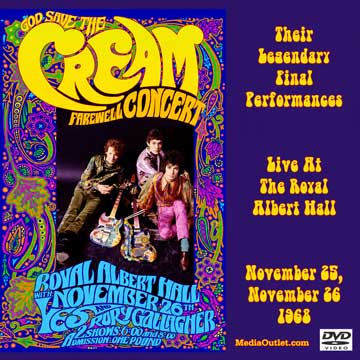
May 14, 1943: #BOTD: #HBD! Jack Bruce,
Scottish-English singer-songwriter and bass player, known
primarily for his contributions to the British supergroup Cream,
which also included the guitarist-singer Eric Clapton and the
drummer Ginger Baker, member of the British blues bands Blues
Incorporated, The Graham Bond Organisation, and West, Bruce and
Laing (d. October 25, 2014) is #born John Symon Asher Bruce in
Bishopbriggs, Lanarkshire, Scotland. Bruce maintained a solo
career that spanned several decades and also played in several
musical groups. Although recognized first and foremost as a
vocalist, bassist and songwriter, he also played double bass,
harmonica, piano, cello and guitar. He was trained as a classical
cellist and considered himself a jazz musician, although much of
his catalogue of compositions and recordings tended toward rock
and blues. In March 2011 Rolling Stone readers selected him as the
eighth greatest bass guitarist of all time. Jack Bruce died of
liver disease in Sudbury, Suffolk, England, aged 71. His ashes are
buried below the statue of an angel at Golders Green Crematorium
in Golders Green, London Borough Of Barnet, England. On Sale @ 15%
Off Discount Till Midnight PT!
https://store.earthstation1.com/cream-farewell-concerts-at-royal-albert-hall-1968-plus-bonus-mp19684.html
Today's
EarthStation1.com 15% Off Commemorative Memorial Title: TV Music &
Dance Shows #8 American Action DVD, MP4, USB Flash Drive
Today, May 14, 2026
May 14, 1944: #BOTD: #HBD! Gene Cornish,
Canadian/American guitarist and harmonica player is born in
Ottawa, Ontario, Canada. He is an original member of the popular
1960s blue-eyed soul band The Young Rascals. From 1965 to 1970,
the band recorded eight albums and had thirteen singles that
reached Billboard's Top 40 chart. In 1997, as a founding member of
The Rascals, Cornish was inducted into the Rock & Roll Hall of
Fame in 1997. Cornish, along with fellow Rascals original member
Dino Danelli, continued to tour with "The New Rascals"
until Danelli's death. On Sale @ 15% Off Discount Till Midnight
PT!
https://store.earthstation1.com/classic-tv-music-amp-dance-shows-8-where-american-action-is-dv8.html
Today's
EarthStation1.com 15% Off Commemorative Memorial Title: George
Lucas: Heroes Myths And Magic Documentary DVD MP4 USB Drive
Today, May 14, 2026
May 14, 1944: #BOTD: #HBD! George Lucas,
American film director, producer, screenwriter, and entrepreneur,
is #born George Walton Lucas Jr. born in Modesto, California where
he is raised, the son of Dorothy Ellinore Lucas (nee Bomberger)
and George Walton Lucas Sr., and is of German, Swiss-German,
English, Scottish, and distant Dutch and French descent. Lucas is
best known for creating the Star Wars and Indiana Jones franchises
and founding Lucasfilm, LucasArts, and Industrial Light &
Magic. He served as chairman of Lucasfilm before selling it to The
Walt Disney Company in 2012. Lucas is one of history's most
financially successful filmmakers and has been nominated for four
Academy Awards. His films are among the 100 highest-grossing
movies at the North American box office, adjusted for ticket-price
inflation. Lucas is considered a significant figure of the
20th-century New Hollywood movement. After graduating from the
University of Southern California in 1967, Lucas co-founded
American Zoetrope with filmmaker Francis Ford Coppola. Lucas wrote
and directed THX 1138 (1971), based on his earlier student short
Electronic Labyrinth: THX 1138 4EB, which was a critical success
but a financial failure. His next work as a writer-director was
the film American Graffiti (1973), inspired by his youth in the
early 1960s Modesto, California, and produced through the newly
founded Lucasfilm. The film was critically and commercially
successful and received five Academy Award nominations, including
Best Director and Best Picture. Lucas's next film, the epic space
opera Star Wars (1977), had a troubled production but was a
surprise hit, becoming the highest-grossing film at the time,
winning six Academy Awards and sparking a cultural phenomenon.
Lucas produced and co-wrote the sequels The Empire Strikes Back
(1980) and Return of the Jedi (1983). With director Steven
Spielberg, he created, produced, and co-wrote the Indiana Jones
films Raiders of the Lost Ark (1981), The Temple of Doom (1984),
The Last Crusade (1989) and The Kingdom of the Crystal Skull
(2008). Lucas is also known for his collaboration with composer
John Williams, who was recommended to him by Spielberg, and with
whom he has worked for all the films in both of these franchises.
He also produced and wrote a variety of films and television
series through Lucasfilm between the 1970s and the 2010s. In 1997,
Lucas re-released the Star Wars Trilogy as part of a special
edition featuring several alterations; home media versions with
further changes were released in 2004 and 2011. He returned to
directing with a Star Wars prequel trilogy comprising Star Wars:
Episode I - The Phantom Menace (1999), Star Wars: Episode II -
Attack of the Clones (2002) and Star Wars: Episode III - Revenge
of the Sith (2005). He last collaborated on the CGI-animated
television series Star Wars: The Clone Wars (2008-2014, 2020), the
war film Red Tails (2012), and the CGI film Strange Magic (2015).
On Sale @ 15% Off Discount Till Midnight PT!
https://store.earthstation1.com/george-lucas-heroes-myths-and-magic-documentary-dvd-mp4-usb-driv4.html
Today's
EarthStation1.com 15% Off Commemorative Memorial Title: Arab And
Jew: Wounded Spirits In A Promised Land DVD, Download, USB
Today, May 14, 2026
May 14, 1948: The Aftermath Of World War
II: The Cold War: The Arab-Israeli Conflict: The 1948 Palestine
War: The 1947-1948 Civil War In Mandatory Palestine: The Israeli
Declaration Of Independence (The Declaration Of The Establishment
Of The State Of Israel): The 1948 Arab-Israeli War (The First
Arab-Israeli War): -- Israel is declared to be an independent
state and a provisional government is established. The Israeli
Declaration of Independence was proclaimed by David Ben-Gurion,
the Executive Head Of The World Zionist Organization, Chairman Of
The Jewish Agency For Palestine, and soon to be first Prime
Minister of Israel. It declared the establishment of a Jewish
state in Eretz-Israel, to be known as The State Of Israel, which
would come into effect on termination of the British Mandate at
midnight that day. The event is celebrated annually in Israel as
Independence Day, a national holiday on 5 Iyar of every year
according to the Hebrew calendar. The country soon became a
destination for tens of thousands of Nazi Holocaust survivors and
a strong U.S. ally. Immediately after the declaration, Israel is
attacked by the neighboring Arab states, triggering the 1948
Arab-Israeli War. ========= May 14, 2018: Israel: The History Of
Israel: Modern Israel: The History Of Modern Israel: Israel-United
States Relations: Diplomatic Missions In Israel: Diplomatic
Missions Of The United States: The Embassy Of The United States Of
America In Jerusalem (The Embassy Of The United States, Jerusalem)
-- The United States moves its embassy in Israel from Tel Aviv to
Jerusalem, inflaming Palestinian resentment who, like Israel,
claim Jerusalem as the capital of a future Palestinian state. The
Embassy Of The United States Of America In Jerusalem is located in
Talpiot, a neighborhood in southeastern Jerusalem. In mid-October
2018, Mike Pompeo, Secretary Of State under the Trump
administration, declared that the new embassy would be merging
with the Consulate General, through which the United States had
maintained diplomatic relations with the Palestinian Authority.
Currently, all diplomacy between the United States and the
Palestinians is conducted through the "Office Of Palestine
Affairs" inside of the American embassy for Israel. On Sale @
15% Off Discount Till Midnight PT!
https://store.earthstation1.com/arab-and-jew-wounded-spirits-in-a-promised-land-dvd.html
Today's
EarthStation1.com 15% Off Commemorative Memorial Title: Music
Documentaries III Video Pioneers Tom Waits Turtles DVD, MP4, USB
Today, May 14, 2026
May 14, 1952: #BOTD: #HBD! David Byrne,
Scottish-American singer, songwriter, producer, and actor,
founding member, principal songwriter, and lead singer and
guitarist of the American new wave band Talking Heads (1975-1991)
is #born in Dumbarton, Dunbartonshire, Scotland. Byrne is a
multi-instrumentalist and is known for his distinctive voice.
Since then, Byrne has released his own solo recordings and worked
with various media including film, photography, opera, fiction and
non-fiction. He has received Oscar, Grammy, and Golden Globe
awards and been inducted into the Rock and Roll Hall of Fame. On
Sale @ 15% Off Discount Till Midnight PT!
https://store.earthstation1.com/music-documentaries-iii-dvd-video-pioneers-tom-waits-turtles.html
Today's
EarthStation1.com 15% Off Commemorative Memorial Title: Global
Rivals: History Of Cold War w/Marvin Kalb DVD, MP4, USB Drive
Today, May 14, 2026
May 14, 1955: The Aftermath Of World War
II: The Cold War: Intergovernmental Organizations: International
Organizations: Military Alliances: The Cold War: The Treaty Of
Friendship (The Warsaw Pact): -- Eight Communist bloc countries,
including the Soviet Union, join The Warsaw Treaty Organization:
(WTO) as they sign The Treaty of Friendship, a mutual defense
treaty popularly known as the Warsaw Pact. The Warsaw Treaty
Organization was a collective defense treaty signed in Warsaw,
Poland, between the Soviet Union and seven other Eastern Bloc
socialist republics of Central and Eastern Europe - Albania,
Bulgaria, Czechoslovakia, East Germany, Hungary, Poland, Romania
and Soviet Union in total. The Warsaw Pact was the military
complement to the Council For Mutual Economic Assistance
(CoMEcon), the regional economic organization for the socialist
states of Central and Eastern Europe. The Warsaw Pact was created
in reaction to the integration of West Germany into NATO in 1955
as per the London and Paris Conferences of 1954. Dominated by the
Soviet Union, the Warsaw Pact was established as a balance of
power or counterweight to NATO. There was no direct military
confrontation between the two organisations; instead, the conflict
was fought on an ideological basis and in proxy wars. Both NATO
and the Warsaw Pact led to the expansion of military forces and
their integration into the respective blocs. Its largest military
engagement was the Warsaw Pact Invasion Of Czechoslovakia in
August 1968 (with the participation of all Pact nations except
Albania and Romania), which, in part, resulted in Albania
withdrawing from the Pact less than a month later. The Pact began
to unravel with the spread of the Revolutions Of 1989 through the
Eastern Bloc, beginning with the Solidarity movement in Poland,
its electoral success in June 1989 and the Pan-European Picnic in
August 1989. East Germany withdrew from the Pact following German
reunification in 1990. On February 25, 1991, at a meeting in
Hungary, the Pact was declared at an end by the defense and
foreign ministers of the six remaining member states. The USSR
itself was dissolved in December 1991, although most of the former
Soviet republics formed the Collective Security Treaty
Organization shortly thereafter. In the following 20 years, the
Warsaw Pact countries outside the USSR each joined NATO (East
Germany through its reunification with West Germany; and the Czech
Republic and Slovakia as separate countries), as did the Baltic
states which had been part of the Soviet Union. On Sale @ 15% Off
Discount Till Midnight PT!
https://store.earthstation1.com/global-rivals-history-of-cold-war-w-mavin-kalb-dvd-mp4-usb-driv4.html
Today's
EarthStation1.com 15% Off Commemorative Memorial Title: Hoover Vs
The Kennedys The Second Civil War TV Series MP4 Download DVD
Today, May 14, 2026
May 14, 1961: Civil Rights Movements: The
American Civil Rights Movement (1954-1968): Anti-Black Racism In
The United States: Segregation: Racial Segregation: Civil Rights
Protests: Civil Rights Protests In The United States: Transport
And Bus Segregation In The United States: The Freedom Riders: The
Journey Of Reconciliation (The First Freedom Ride): The Anniston
Bus Bombing: -- On Mother's Day Sunday, a mob of Klansmen, some
still in church attire, attacked a Freedom Riders bus at the
Anniston Trailways Terminal, at 901 Noble St., Anniston, Alabama,
the first of the two Greyhound buses which were to set out
carrying Freedom Riders that day (the other headed to Birmingham
towards its own awful destiny), headed south to protest in
accordance of a recent Supreme Court ruling that bus segregation
was unconstitutional. The Birmingham, Alabama Police Commissioner,
Bull Connor, together with Police Sergeant Tom Cook (an avid Ku
Klux Klan supporter), organized violence against the Freedom
Riders with local Klan chapters. The pair made plans to bring the
Ride to an end in Alabama. They assured Gary Thomas Rowe, an FBI
informer and member of Eastview Klavern #13 (the most violent Klan
group in Alabama), that the mob would have fifteen minutes to
attack the Freedom Riders without any arrests being made. The plan
was to allow an initial assault in Anniston with a final assault
taking place in Birmingham. The bus driver tried to leave the
station, but he was blocked until KKK members slashed its tires.
The mob forced the crippled bus to stop several miles outside town
and then threw a firebomb into it. As the bus burned, the mob held
the doors shut, intending to burn the riders to death. Sources
disagree, but either an exploding fuel tank or an undercover state
investigator who was brandishing a revolver caused the mob to
retreat, and the riders escaped the bus. The mob beat the riders
after they got out. Warning shots which were fired into the air by
highway patrolmen were the only thing which prevented the riders
from being lynched. Some injured riders were taken to Anniston
Memorial Hospital. That night, the hospitalized Freedom Riders,
most of whom had been refused care, were removed from the hospital
at 2 AM, because the staff feared the mob outside the hospital.
The local civil rights leader Rev. Fred Shuttlesworth organized
several cars of black citizens to rescue the injured Freedom
Riders in defiance of the white supremacists. The black people
were under the leadership of Colonel Stone Johnson and were openly
armed as they arrived at the hospital, protecting the Freedom
Riders from the mob. The roadside site in Anniston and the
downtown Greyhound station were preserved as part of the Freedom
Riders National Monument in 2017. Later, when the Trailways bus
reached Anniston and pulled in at the terminal an hour after the
Greyhound bus was burned, it was boarded by eight Klansmen. They
beat the Freedom Riders and left them semi-conscious in the back
of the bus. The Freedom Riders were civil rights activists who
rode interstate buses into the segregated southern United States
in 1961 and subsequent years to challenge the non-enforcement of
the United States Supreme Court decisions Morgan v. Virginia
(1946) and Boynton v. Virginia (1960), which ruled that segregated
public buses were unconstitutional. The Southern states had
ignored the rulings and the federal government did nothing to
enforce them. The first Freedom Ride left Washington, D.C., on May
4, 1961, and was scheduled to arrive in New Orleans on May 17.
Boynton outlawed racial segregation in the restaurants and waiting
rooms in terminals serving buses that crossed state lines. Five
years prior to the Boynton ruling, the Interstate Commerce
Commission (ICC) had issued a ruling in Sarah Keys v. Carolina
Coach Company (1955) that had explicitly denounced the Plessy v.
Ferguson (1896) doctrine of separate but equal in interstate bus
travel. The ICC failed to enforce its ruling, and Jim Crow travel
laws remained in force throughout the South. The Freedom Riders
challenged this status quo by riding interstate buses in the South
in mixed racial groups to challenge local laws or customs that
enforced segregation in seating. The Freedom Rides, and the
violent reactions they provoked, bolstered the credibility of the
American Civil Rights Movement. They called national attention to
the disregard for the federal law and the local violence used to
enforce segregation in the southern United States. Police arrested
riders for trespassing, unlawful assembly, violating state and
local Jim Crow laws, and other alleged offenses, but often they
first let white mobs attack them without intervention. The
Congress Of Racial Equality (CORE) sponsored most of the
subsequent Freedom Rides, but some were also organized by the
Student Nonviolent Coordinating Committee (SNCC). The Freedom
Rides followed dramatic sit-ins against segregated lunch counters
conducted by students and youth throughout the South, and boycotts
of retail establishments that maintained segregated facilities.
The Supreme Court's decision in Boynton supported the right of
interstate travelers to disregard local segregation ordinances.
Southern local and state police considered the actions of the
Freedom Riders to be criminal and arrested them in some locations.
In some localities, such as Birmingham, Alabama, the police
cooperated with Ku Klux Klan chapters and other white people
opposing the actions, and allowed mobs to attack the riders. On
Sale @ 15% Off Discount Till Midnight PT!
https://store.earthstation1.com/hoover-vs-the-kennedys-the-second-civil-war-tv-series-mp4-download-dv4.html
Today's
EarthStation1.com 15% Off Commemorative Memorial Title: Dominoes:
Popular Culture During The Vietnam War DVD, MP4, USB Drive
Today, May 14, 2026
May 14-15, 1970: The Aftermath Of World
War II: The Cold War: The Cold War In Asia: The Indochina Wars:
The Vietnam War (The Second Indochina War, The Vietnam Conflict,
The Resistance War Against America): The United States In The
Vietnam War: Opposition To United States Involvement In The
Vietnam War: The 1970 Jackson State College Killings: -- A group
of around a hundred African American student protesters against
the Vietnam War generally, and the U.S. Invasion Of Cambodia
specifically, gather on Lynch Street, a major thoroughfare that
divided the campus of Jackson State College (now Jackson State
University (JSU) in Jackson, Mississippi, which linked West
Jackson to downtown, a well known site for racial intimidation and
harassment by white motorists. Around 9:30 p.m., in reaction to a
rumor that Fayette, Miss. Mayor Charles Evers (brother of slain
civil rights activist Medgar Evers) and his wife had been shot and
killed, the students start fires, throw rocks at motorists, and
overturn vehicles, including a large truck. Firefighters at the
scene quickly requested police support. The police responded in
force. At least 75 Jackson police units from the city and the
Mississippi Highway Patrol attempted to control the crowd while
the firemen extinguished the fires. After the firefighters had
left, shortly before midnight, the police moved to disperse the
crowd then gathered in front of Alexander Hall, a five-story
women's dormitory. Advancing to within 50-100 feet of the crowd,
at roughly 12:05 a.m. on May 15, officers opened fire on the
dormitory, killing two African American students and injuring
twelve African Americans. Authorities claimed they saw a sniper on
one of the building's upper floors but an FBI search for evidence
of sniper fire was negative. At least 140 shots - some estimate
more than 460 - were fired by a reported 40 state highway
patrolmen using shotguns from 30 to 50 feet. Every window on the
side of the building facing Lynch Street was shattered. This
violence occurred only eleven days after National Guardsmen killed
four students in similar protests at Kent State University in
Ohio, which had first captured national attention. College
campuses across the country were in turmoil over the fresh
expansion of the war. Phillip Lafayette Gibbs, 21, a junior
pre-law major and father of an 18 month-old son, and James Earl
Green, 17, a senior at nearby Jim Hill High School who was walking
home from work at a local grocery store when he stopped to watch
the action, were killed; 12 others were wounded. But ambulances
were not called until after the officers picked up their shell
casings, a U.S. Senate probe conducted by Sens. Walter Mondale and
Birch Bayh later revealed. There were no arrests in connection
with the deaths at Jackson State, although the President's
Commission on Campus Unrest concluded "that the 28-second
fusillade from police officers was an unreasonable, unjustified
overreaction_A broad barrage of gunfire in response to reported
and unconfirmed sniper fire is never warranted." The
university has memorialized the shootings by naming the area the
Gibbs-Green Plaza. A large stone monument in front of Alexander
Hall near the plaza honors the two victims. On Sale @ 15% Off
Discount Till Midnight PT!
https://store.earthstation1.com/dominoes-us-life-during-vietnam-war-set-to-rock-music-video.html
Today's
EarthStation1.com 15% Off Commemorative Memorial Title: Missions
To The Moon: Apollo Program To Moon & Skylab DVD, MP4, USB
Today, May 14, 2026
May 14, 1973: Rocket Launches: The
History Of Spaceflight: The Aftermath Of World War II: The Cold
War: The Space Age: Space Programs Of The United States: Human
Spaceflight Programs: Space Stations: Skylab: -- The United
States' first space station, Skylab, is launched at 17:30:00 UTC
atop a modifed Saturn V super heavy-lift launch vehicle from
Kennedy Space Center Launch Complex 39A (LC-39A). Skylab stayed in
low Earth orbit from 1973 to 1979, when it fell back to Earth amid
huge worldwide media attention. Launched and operated by NASA,
Skylab included a workshop, a solar observatory, and other systems
necessary for crew survival and scientific experiments. It was
launched unmanned by a modified Saturn V rocket, with a weight of
170,000 pounds (77 t). Lifting Skylab into low earth orbit was the
final mission and launch of a Saturn V rocket, the booster famous
for carrying the manned Moon landing missions. There were a total
of three manned expeditions to the station, conducted between May
1973 and February 1974. Each mission delivered a three-astronaut
crew in the Apollo Command/Service Module (Apollo CSM) launched
atop the smaller Saturn IB rocket. For the final two manned
missions to Skylab, a backup Apollo CSM/Saturn IB was assembled
and made ready in case an in-orbit rescue mission was needed, but
this backup vehicle was never flown. The station was damaged
during launch when the micrometeoroid shield tore away from the
workshop, taking one of the main solar panel arrays with it and
jamming the other main array. This deprived Skylab of most of its
electrical power, and also removed protection from intense solar
heating, threatening to make it unusable. However, the first crew
was able to save Skylab by deploying a replacement heat shade and
freeing the jammed solar panels. This was the first time a repair
of this magnitude had been performed in space. Skylab included the
Apollo Telescope Mount (a multi-spectral solar observatory),
Multiple Docking Adapter (with two docking ports), Airlock Module
with extravehicular activity (EVA) hatches, and the Orbital
Workshop (the main habitable space inside Skylab). Electrical
power came from solar arrays, as well as fuel cells in the docked
Apollo CSM. The rear of the station included a large waste tank,
propellant tanks for maneuvering jets, and a heat radiator.
Numerous experiments were conducted aboard Skylab during its
operational life. Solar science was significantly advanced by the
telescope, and observation of the Sun was unprecedented. Thousands
of photographs of Earth were taken, and the Earth Resources
Experiment Package (EREP) viewed Earth with sensors that recorded
data in the visible, infrared, and microwave spectral regions. The
record for human time spent in orbit was extended beyond the 23
days set by the Soyuz 11 crew aboard Salyut 1, to 84 days by the
Skylab 4 crew. Later plans to reuse Skylab were stymied by delays
in development of the Space Shuttle and Skylab's decaying orbit
could not be stopped. Skylab's atmospheric reentry began on July
11, 1979. Before re-entry, NASA ground controllers tried to adjust
Skylab's orbit to minimize the risk of debris landing in populated
areas, with their target - the south Indian Ocean - partially
successful. However, debris spectacularly showered Western
Australia; recovered pieces indicated that the station had
disintegrated lower than expected. As the Skylab program drew to a
close, NASA's focus had shifted to the development of the Space
Shuttle. After Skylab, NASA space station/laboratory projects
included Spacelab, Shuttle-Mir, and Space Station Freedom (which
was later merged into the International Space Station). On Sale @
15% Off Discount Till Midnight PT!
https://store.earthstation1.com/missions-to-the-moon-apollo-program-to-moon-skylab-dvd-mp4-us4.html
Today's
EarthStation1.com #OnThisDay Commemorative Memorial Title: Fight
Against Fanaticism! Anti-Repression Films DVD, MP4, USB Drive
Today, May 14, 2026 May 14: National Decency Day: -- A day to
make it a point to spread the message of how a decent human being
can lead to the overall progress of a society. National Decency
Day was created by a New York-based graphic designer Lisa Cholnoky
in 2017 after she witnessed a heated political debate amongst
relatives. Seeing how aggressive people get when speaking of
anything concerning their beliefs, Lisa came up with the idea of
promoting 'decency' during any kind of discourse that takes place
between people. To spread the idea, Lisa designed a 'DECENCY'
button and endorsed the message by wearing it every day. The three
points that the designer spoke of included: Active Listening,
Better Understanding, and Compassion. The minute the idea was
launched, people jumped on the bandwagon and began supporting the
cause. Today, every May 14, the mission of spreading decency is
celebrated to bring back the public dignity all Americans deserve.
Furthermore, to drive attention to the cause of decency, Lisa
mailed 536 'DECENCY' buttons to the U.S. Congress in July 2017.
This move led to the recognition of the movement amongst
politicians who further encouraged people to conduct discussions
and debates in accordance with the rules of decency. This,
furthermore, made numerous schools and towns realize how essential
spreading awareness regarding decency is. In fact, educational
institutes in around 25 States have enlisted themselves in their
community's own 'Day of Decency' so students and family members
are all involved with the cause by introducing projects and
discussions. According to Lisa Cholnoky, our children desperately
need role models. "If we can all be civil with one another,
we are setting the right example," she stated.
https://store.earthstation1.com/fight-against-fanaticism-us-antirepression-films-dvd.html
Today's
EarthStation1.com #OnThisDay Commemorative Memorial Title: Lewis
And Clark & The Corps Of Discovery Expedition DVD MP4 USB
Stick
Today, May 14, 2026May 14, 1804: The Exploration Of North
America: The United States: The History Of The United States: The
Territorial Expansion Of The United States (The Territorial
Evolution Of The United States): The Louisiana Purchase: The Lewis
And Clark Expedition (The Corps Of Discovery, The Corps Of
Discovery Expedition): The Corps Of Discovery: -- The Lewis And
Clark Expedition begins its historic journey as it departs from
Camp Dubois and travels up the Missouri River. The Lewis And Clark
Expedition (May 1804 - September 1806), also known as the Corps of
Discovery Expedition, was the first American expedition to cross
what is now the western portion of the United States. It began
near St. Louis, made its way westward, and passed through the
continental divide to reach the Pacific coast. The Corps of
Discovery comprised a selected group of U.S. Army volunteers under
the command of Captain Meriwether Lewis and his close friend,
Second Lieutenant William Clark. The Louisiana Purchase was the
acquisition of the Louisiana territory (828,000 square miles) by
the United States from France in 1803. The U.S. paid 50M francs
and a cancellation of debts worth 18M francs for a total of 68M
francs (15M USD, equivalent to 300M USD in 2016). The Louisiana
Purchase territory contained land that forms Arkansas, Missouri,
Iowa, Oklahoma, Kansas, and Nebraska; the portion of Minnesota
west of the Mississippi River; a large portion of North Dakota; a
large portion of South Dakota; the northeastern section of New
Mexico; the northern portion of Texas; the area of Montana,
Wyoming, and Colorado east of the Continental Divide; and
Louisiana west of the Mississippi River (plus New Orleans). Its
non-native population was around 60,000 inhabitants, of whom half
were African slaves. The Corps of Discovery was a
specially-established unit of the United States Army created from
a select group of volunteers which formed the nucleus of the Lewis
And Clark Expedition. Commissioned by President Thomas Jefferson,
the Corps' objectives were both scientific and commercial: to
study the area's plants, animal life, and geography, and to learn
how the Louisiana Purchase could be exploited economically.
https://store.earthstation1.com/lewis-amp-clark-amp-the-corps-of-discovery-dvd-mp4-usb-driv4.html
Today's
EarthStation1.com #OnThisDay Commemorative Memorial Title: The
American Adventure: TV History Series 1607-1876 DVD MP4 USB Drive
Today, May 14, 2026May 14, 1836: The American Frontier (The
American West, The Wild West, The Old West): The Texas Revolution:
The Battle Of San Jacinto: The Treaties Of Velasco: -- Two
documents, one private and the other public, are signed in Fort
Velasco between General Antonio Lopez de Santa Anna and the
Republic of Texas in the aftermath of the Battle of San Jacinto of
April 21, 1836. Texas intended the agreements to conclude
hostilities between the two armies and offer the first steps
toward the official recognition of Texas's independence from
Mexico. At their drafting, the documents were called a "Public
Agreement" and a "Secret Treaty". The part of the
former Velasco, Texas, in which the fort was located is now part
of the present-day location of Surfside Beach. The signatories
were Interim President David G. Burnet for Texas and Santa Anna
for Mexico. Santa Anna had been captured by Texans; many wanted
him hanged as just vengeance for the murder of comrades and family
during the battles at Alamo and Goliad, but Sam Houston spared his
life and extracted a promise from Santa Anna that Mexican troops
would be removed from Texas. Santa Anna persuaded Burnet that if
he were allowed to return to Mexico City, he would argue for the
independence of Texas. Santa Anna signed both the public agreement
and the secret treaty, but neither was ratified as a treaty by the
Mexican government because he had signed them under duress while
being held captive. Santa Anna later said, "I did promise to
try to get a hearing for the Texas Commissioners, but this in
itself did not bind the government to receive them." The
Mexican Congress considered Santa Anna's actions scandalous and
nullified both. Mexican conservatives removed Santa Anna as
president and installed Anastasio Bustamante, and there was an
agreement with the Mexican Congress that Santa Anna had "offered
nothing in the name of the nation." A biographer of Santa
Anna, Will Fowler, considered that the "general of tricks was
at his most ingenious" with the negotiations with Texas since
he did not commit himself to do anything other than to permit
Texas commissioners to present their case to the Mexican
government. He was "no longer in a position to act freely,
and anything he said or signed would not be validated by Congress"
since as a captive, he was no longer president. A draft of the
agreement, which Santa Anna refused to sign until it was amended,
stated that he recognized as "Head of the Mexican Nation"
Texas's independence, text that was later dropped. Santa Anna sent
a message to General Vicente Filisola to retreat below the Rio
Grande, but his message made it clear that Filisola was in charge.
Fowler argues that Filisola should have known that Santa Anna was
in no position to be issuing orders since he had been captured.
Both Filisola and Santa Anna were blamed for the defeat, but
signing the Velasco documents did not commit either Santa Anna or
Mexico to Texas independence. Mexico still claimed Texas but was
too weak to attempt to reconquer it; thus, Texas was de facto
independent. The documents were not even called "treaties"
until they were so characterized by U.S. President James K. Polk
in his justifications for war some ten years later, as U.S.
Representative Abraham Lincoln pointed out in 1848. Lincoln's
efforts earned the freshman Whig U.S. Representative the derisive
sobriquet "Spotty" Lincoln because of his Spot
Resolutions, which demanded to know that the "spot" at
which American troops were killed was on American soil, which Polk
argued to justify war with Mexico.
https://store.earthstation1.com/the-american-adventure-series-us-1st-century-4-dv14.html
Today's
EarthStation1.com #OnThisDay Commemorative Memorial Title: The
Siege Of Vicksburg American Civil War DVD MP4 Download USB Drive
Today, May 14, 2026May 14, 1863: The American Civil War (The
Civil War, The War Between The States): The Western Theater Of The
American Civil War: The Vicksburg Campaign: The Battle Of Jackson:
-- The Battle Of Jackson takes place in Jackson, Mississippi.
After entering the state of Mississippi in late April 1863, Major
General Ulysses S. Grant of the Union Army moved his force inland
to strike at the strategic Mississippi River town of Vicksburg,
Mississippi. The Battle of Raymond, which was fought on May 12,
convinced Grant that General Joseph E. Johnston's Confederate army
was too strong to be safely bypassed, so he sent two corps, under
Major Generals James B. McPherson and William T. Sherman, to
capture Johnston's position at Jackson. Johnston did not believe
the city was defensible and began withdrawing. Brigadier General
John Gregg was tasked with commanding the Confederate rear guard,
which fought Sherman's and McPherson's men at Jackson on May 14
before withdrawing. After taking the city, Union troops destroyed
economic and military infrastructure and also plundered civilians'
homes. Grant then moved against Vicksburg, which he placed under
siege on May 18 and captured on July 4. Despite being reinforced,
Johnston made only a weak effort to save the Vicksburg garrison,
and was driven out of Jackson a second time in mid-July.
https://store.earthstation1.com/the-siege-of-vicksburg-american-civil-war-dvd-mp4-download-usb-driv4.html
Today's
EarthStation1.com #OnThisDay Commemorative Memorial Title: TV
Commercials: The Classics Vol. 1 DVD, Video Download, USB Drive
Today, May 14, 2026May 14, 1919: #DOTD: #RIP: Henry J.
Heinz, American entrepreneur and businessman, founder of the H. J.
Heinz Company (b. October 11, 1844) #dies at his home in
Pittsburgh, Pennsylvania after contracting pneumonia, aged 74. His
funeral was held at East Liberty Presbyterian Church. He is buried
at Homewood Cemetery in Pittsburgh, in the Heinz Family Mausoleum.
A bronze statue of Heinz by Emil Fuchs was dedicated on October
11, 1924, at the Heinz Company building in Pittsburgh. Henry J.
Heinz was born Henry John Heinz in Birmingham, Pennsylvania. At
the age of 25, he co-founded a small horseradish concern in
Sharpsburg, Pennsylvania. This business failed, but his second
business expanded into tomato ketchup and other condiments, and
ultimately became the internationally known H. J. Heinz Company of
Pittsburgh, Pennsylvania. He was involved in the passage of the
1906 Pure Food and Drug Act. Many of his descendants are known for
philanthropy and involvement in politics and public affairs. His
fortune became the basis for the philanthropic Heinz Foundations.
https://store.earthstation1.com/tv-commercials-the-classics-vol-1-dv1.html
Today's
EarthStation1.com #OnThisDay Commemorative Memorial Title: Pearl
Harbor Two Hours That Changed The World Special MP4 Download DVD
Today, May 14, 2026May 14, 1968: #DOTD: #RIP: Husband E.
Kimmel, American admiral who at the time of the Japanese attack on
Pearl Harbor commander in chief of the United States Fleet
(CINCUS) and the U.S. Pacific Fleet (CINCPACFLT) (b. February 26,
1882) #dies in Groton, Connecticut, aged 86. He is buried at The
United States Naval Academy Cemetery in Annapolis, Maryland.
Husband E. Kimmel was born Husband Edward Kimmel in Henderson,
Kentucky to Sibella "Sibbie" Lambert Kimmel (1846-1919)
and Major Manning Marius Kimmel (1832-1916), a graduate of West
Point who fought with the Union side during the American Civil War
before switching allegiance to the Confederate States Army to
fight alongside his neighbors. Admiral Kimmel was removed from
command after the December 1941 attack and reduced from four-star
to the two-star rank of rear admiral. He retired from the Navy in
early 1942. Historians agree that the United States was completely
unprepared for the Japanese attack on Pearl Harbor at all levels.
Japanese military forces enjoyed clear superiority in training,
equipment, experience and planning over the Americans. The extent
to which Kimmel himself bore responsibility for the unreadiness of
his Pacific Fleet has been a matter of debate. Some, such as
submarine Captain Edward L. "Ned" Beach, concluded that
Admiral Kimmel and General Short, who was also dismissed from
command, were made scapegoats for the failures of superiors in
Washington. Kimmel's supporters point to a series of bureaucratic
foul-ups and circumstances beyond anyone's control that led to the
fleet's lack of preparedness, including poor atmospheric
conditions that blocked a radio warning from the War Department to
Pearl Harbor of a possible attack, forcing it to be sent as a
telegram, which delayed it long enough for the attack to start
before Kimmel could get it. Edwin T. Layton (later Rear Admiral
Layton), chief intelligence officer for Kimmel and one of the
officers who knew Kimmel best, provided support for Kimmel's
position. Layton argued Kimmel had not been provided complete
information and that Kimmel deployed the few reconnaissance
resources at his disposal in the most logical way, given the
available information. On the other hand, Kimmel's critics point
out that he had been ordered 10 days prior to the attack to
initiate a "defensive deployment" of the fleet. Kimmel,
thinking the main threat to the fleet was sabotage, kept much of
the fleet in port and did not place the fleet on alert. When his
intelligence unit lost track of Japan's aircraft carriers, he did
not order long-range air or naval patrols to assess their
positions. In 1994 Kimmel's family, including his grandson, South
Carolina broadcaster Manning Kimmel IV, attempted for the third
time to have Kimmel's four-star rank reinstated. President Bill
Clinton denied the request, as had Presidents Richard Nixon and
Ronald Reagan. On May 25, 1999, the United States Senate, by a
vote of 52-47, passed a non-binding resolution to exonerate Kimmel
and Short and requested that the President of the United States
posthumously restore both men to full rank. President Clinton did
not act on the resolution, nor did his successors, George W. Bush
and Barack Obama. The Senate enquiry in 2000 issued a lengthy
exoneration of Kimmel's conduct.
https://store.earthstation1.com/pearl-harbor-two-hours-that-changed-the-world-special-mp4-download-dvd.html
Today's
EarthStation1.com #OnThisDay Commemorative Memorial Title: The
History Of Jazz A Video Retrospective DVD, MP4 Download, USB Drive
Today, May 14, 2026May 14, 1897: #BOTD: #HBD! / May 14,
1959: #DOTD: #RIP: Sidney Bechet, African American jazz composer,
clarinetist, saxophonist, pianist and drummer, first musician to
develop the Swing style of jazz and one of jazz's first important
soloists and beating trumpeter, former band mate and fellow New
Orleanian Louis Armstrong to the recording studio by several
months, called by some French existentialists "Le Dieu"
("The God") is #born in 1897 to a Catholic middle-class
Creole Of Color family. In 1919, Swiss classical music conductor
Ernest Ansermet, wrote a tribute to Bechet, one of if not the
earliest classical music tribute to a jazz musician, linking
Bechet's music with that of Bach's. Bechet never learned how to
read music in his lifetime of being a musician. His erratic
temperament hampered his career, and not until the late 1940s did
he earn wide acclaim. In 2013, a crater on Mercury was named after
Bechet. In the novel Steppenwolf by Hermann Hesse, Bechet was
inspiration for the character "Pablo." As with many
American blacks artists of his time, Bechet spent much of his
later life in France, where he was appreciated by a wider audience
and had more general freedom than he did in the United States.
Bechet's shoemaker father Omar was a flute player, and all four of
his brothers were musicians as well. Bechet learned and mastered
several musical instruments that were kept around the house (he
began on the cornet), mostly by teaching himself; he decided to
specialize in the clarinet (which he played almost exclusively
until about 1919). At the age of six, he started to perform with
his brother's band at a family birthday party, debuting his
talents to acclaim. Later in his youth, Bechet studied with King
Oliver, Bunk Johnson, Freddie Keppard, Lorenzo Tio, Big Eye
Delisle, and George Baquet. Bechet played in many New Orleans
ensembles using the improvisational techniques of the time
(obbligatos with scales and arpeggios and varying the melody).
While working with Louis Armstrong, Bechet was the first musician
to develop the Swing style of jazz, and influence the widening
difference between jazz and ragtime. Bechet liked to have his
sound dominate in a performance, and trumpeters reportedly found
it difficult to play alongside him. During the Nineteen Tens and
Nineteen Teens, He performed in parades with Freddie Keppard's
brass band, the Olympia Orchestra, John Robichaux's dance
orchestra, Bunk Johnson in the Eagle Band of New Orleans and King
Oliver in the Olympia Band, and he toured as far north as Chicago.
In the spring of 1919, he traveled to New York City where he
joined Will Marion Cook's Syncopated Orchestra. Soon after, the
orchestra traveled to Europe; almost immediately upon arrival,
they performed at the Royal Philharmonic Hall in London. The group
was warmly received, and Bechet was especially popular. While in
London, he discovered the straight soprano saxophone and developed
a style unlike his clarinet tone. Bechet was the first influential
soprano saxophonist, and led to its rising popularity in jazz. His
saxophone sound could be described as emotional, reckless, and
large. He often used a broad vibrato, similar to some New Orleans
clarinetists at the time. Bechet's first recordings were made in
1923 and 1924 led by Clarence Williams And His Blue Five, which
included Louis Armstrong, and included "Wild Cat Blues"
and "Kansas City Man Blues". In 1924, Bechet worked with
Duke Ellington for three months and made a significant impact on
Ellington's early jazz style. Duke Ellington called him "the
epitome of jazz." On September 15, 1925, Bechet and other
members of the Revue Negre, including Josephine Baker, sailed to
Europe, arriving at Cherbourg, France, on September 22. The revue
opened at the Theatre des Champs-Elysees in Paris on October 2.
The show was an example of negrophilia in France at the time. He
toured Europe with multiple bands, reaching as far as Russia in
mid-1926. In 1928, he led his small band at Chez Bricktop (run by
the popular Ada "Bricktop" Smith) in Montmartre, Paris.
He was imprisoned in Paris for eleven months. In his
autobiography, he wrote that he accidentally shot a woman when he
was trying to shoot a musician who had insulted him. He had
challenged the man to duel and said, "Sidney Bechet never
plays the wrong chord." After his release, he was deported to
New York, arriving soon after the stock market crash of 1929. He
joined with Lorenzo Tio and also came to know trumpeter Roy
Eldridge. In 1932, Bechet returned to New York City to lead a
six-member band with Tommy Ladnier at the Savoy Ballroom. He
played in Noble Sissle's orchestra, which toured in Germany and
Russia. In 1938, "Hold Tight, Hold Tight (Want Some Seafood
Mama)", commonly known as "Hold Tight", was
composed by Bechet's guitarist and one of the first jazz
guitarists to play electric guitar Leonard Ware and two session
singers, with claimed contributions from Bechet himself. The song
became known for its suggestive lyrics and then for a series of
lawsuits over songwriter royalties. In 1939, Bechet and the
pianist Willie "The Lion" Smith led a group that
recorded several early versions of what was later called Latin
Jazz, adapting traditional meringue, rhumba and Haitian songs to
the jazz idiom. On July 28, 1940, Bechet made a guest appearance
on the NBC Radio show The Chamber Music Society Of Lower Basin
Street with Henry Levine's Dixieland band. Levine invited Bechet
into the RCA Victor recording studio (on 24th Street in New York
City), where Bechet lent his soprano sax to Levine's traditional
arrangement of "Muskrat Ramble". On April 18, 1941, as
an early experiment in overdubbing at Victor, Bechet recorded a
version of the pop song "The Sheik of Araby", playing
six different instruments: clarinet, soprano saxophone, tenor
saxophone, piano, bass, and drums. In 1944, 1946, and 1953, he
recorded and performed in concert with the Chicago jazz pianist
and vibraphonist Max Miller. With jobs in music difficult to find,
he opened a tailor shop with Ladnier. They were visited by
musicians and played in the back of the shop. In the 1940s, Bechet
played in several bands, but his financial situation did not
improve until the end of that decade. By the end of the 1940s,
Bechet had tired of struggling to make music in the United States.
His contract with Jazz Limited, a Chicago-based record label, was
limiting the events at which he could perform (for instance, the
label would not permit him to perform at the 1948 Festival of
Europe in Nice). He believed that the jazz scene in the United
States had little left to offer him and was getting stale. In
1951, he migrated to France permanently, after his performance as
a soloist at the Paris Jazz Fair caused a surge in his popularity
in that country, where he easily found well-paid work. Also in
1951, he married the white woman Elisabeth Ziegler in Antibes, a
French city on the coast of the Mediterranean. In 1953, he signed
a recording contract with Disques Vogue that lasted for the rest
of his life. He recorded many hit tunes, including "Les
Oignons", "Promenade Aux Champs-Elysees", and the
international hit "Petite Fleur". He also composed a
classical ballet score in the late Romantic style of Tchaikovsky
called La Nuit est une sorciere ("The Night Is a Witch").
Shortly before his death, Bechet dictated his autobiography, Treat
It Gentle, to Al Rose, a record producer and radio host. He had
worked with Rose several times in concert promotions and had a
fractious relationship with him. Bechet's view of himself in his
autobiography was starkly different from the one Rose knew. "The
kindly old gentleman in his book was filled with charity and
compassion. The one I knew was self-centered, cold, and capable of
the most atrocious cruelty, especially toward women."
Although embellished and frequently inaccurate, Treat It Gentle
remains a staple account for the "insider's view of the New
Orleans tradition." Bechet's music has been included in the
soundtracks of about 60 films, including the following: JFK
(1991), Chocolat (2000), The Quiet American (2002), and Midnight
in Paris (2011). Bechet was known for having an abrasive attitude,
which has been compared to that of Coleman Hawkins. They were both
incredibly sure of their relative importance in the music industry
during a time in which jazz was losing popularity. They were
stubborn and lacked patience with younger artists who had less
experience or knowledge about the jazz industry. Bechet had three
wives: Norma Hale (1918-1929). Marie-Louise Crawford (1934-1942),
and Elizabeth Ziegler (1951-death). Sidney Bechet died in Garches,
near Paris, of lung cancer on his 62nd birthday. He is buried in a
local cemetery.
https://store.earthstation1.com/the-history-of-jazz-by-billy-taylor-parts-i-amp-ii-dvd.html
Today's
EarthStation1.com #OnThisDay Commemorative Memorial Title: Frank
Sinatra: The Voice Of Our Time DVD, Video Download, USB Drive
Today, May 14, 2026May 14, 1998: #DOTD: #RIP: Frank Sinatra,
American singer, actor, producer, pop icon and cultural icon (b.
December 12, 1915) #dies with his wife at his side at Cedars-Sinai
Medical Center in Los Angeles at the age of 82, after a heart
attack. He is buried at Desert Memorial Park, Cathedral City,
California. Francis Albert Sinatra was one of the most popular and
influential musical artists of the 20th century. He is one of the
best-selling music artists of all time, having sold more than 150
million records worldwide. Born in Hoboken, New Jersey to Italian
immigrants, Sinatra began his musical career in the swing era with
bandleaders Harry James and Tommy Dorsey. Sinatra found success as
a solo artist after he signed with Columbia Records in 1943,
becoming the idol of the "bobby soxers". He released his
debut album, The Voice of Frank Sinatra, in 1946. Sinatra'
professional career had stalled by the early 1950s, and he turned
to Las Vegas, where he became one of its best known residency
performers as part of the Rat Pack. His career was reborn in 1953
with the success of From Here to Eternity, with his performance
subsequently winning an Academy Award and Golden Globe Award for
Best Supporting Actor. Sinatra left Capitol in 1960 to start his
own record label, Reprise Records, and released a string of
successful albums. In 1965, he recorded the retrospective
September of My Years, starred in the Emmy-winning television
special Frank Sinatra: A Man and His Music, and released the
tracks "Strangers in the Night" and "My Way".
He recorded Sinatra at the Sands at the Sands Hotel and Casino in
Vegas with frequent collaborator Count Basie in early 1966, and in
1968 he collaborated with Duke Ellington. Sinatra retired for the
first time in 1971, but came out of retirement two years later and
recorded several albums and resumed performing at Caesars Palace,
and reached success in 1980 with "New York, New York".
Using his Las Vegas shows as a home base, he toured both within
the United States and internationally until a short time before
his death in 1998. Sinatra forged a highly successful career as a
film actor. After winning an Academy Award for From Here to
Eternity, he starred in The Man with the Golden Arm (1955), and
received critical acclaim for his performance in The Manchurian
Candidate (1962). He appeared in various musicals such as On the
Town (1949), Guys and Dolls (1955), High Society (1956), and Pal
Joey (1957), winning another Golden Globe for the latter. On
television, The Frank Sinatra Show began on ABC in 1950, and he
continued to make appearances on television throughout the 1950s
and 1960s. Sinatra was also heavily involved with politics from
the mid-1940s, and actively campaigned for presidents such as
Harry S. Truman, John F. Kennedy and Ronald Reagan. Despite his
political connections, the FBI investigated Sinatra and his
alleged relationship with the Mafia. While Sinatra never formally
learned how to read music, he had an impressive understanding of
it, and he worked very hard from a young age to improve his
abilities in all aspects of music. A perfectionist, renowned for
his dress sense and performing presence, he always insisted on
recording live with his band. His bright blue eyes earned him the
popular nickname "Ol' Blue Eyes". Sinatra led a colorful
personal life, and was often involved in turbulent affairs with
women, such as with his second wife Ava Gardner. He went on to
marry Mia Farrow in 1966 and Barbara Marx in 1976. Sinatra had
several violent confrontations, usually with journalists he felt
had crossed him, or work bosses with whom he had disagreements. He
was honored at the Kennedy Center Honors in 1983, was awarded the
Presidential Medal Of Freedom by Ronald Reagan in 1985, and the
Congressional Gold Medal in 1997. Sinatra was also the recipient
of eleven Grammy Awards, including the Grammy Trustees Award,
Grammy Legend Award and the Grammy Lifetime Achievement Award.
After his death, American music critic Robert Christgau called him
"the greatest singer of the 20th century", and he
continues to be seen as an iconic figure.
https://store.earthstation1.com/frank-sinatra-the-voice-of-our-time-dvd-documentary.html
Today's
EarthStation1.com #OnThisDay Commemorative Memorial Title: Rock &
Roll An Unruly History 10 Part TV Series MP4 Video Download DVD
Today, May 14, 2026May 14, 2015: #DOTD: #RIP: B.B. King,
African American blues singer, electric guitarist, songwriter, and
record producer who introduced a sophisticated style of soloing
based on fluid string bending and shimmering vibrato that
influenced many later electric blues guitarists, one of the most
influential blues musicians of all time, earning the nickname "The
King of the Blues", and one of the "Three Kings of the
Blues Guitar" along with Albert King and Freddie King (b.
September 16, 1925) #dies from congestive heart failure and
complications from diabetes at the age of 89 in Las Vegas, Nevada.
He is buried at the B.B. King Museum and Delta Interpretive Center
in Indianola, Mississippi. He was born Riley B. King on a cotton
plantation of Berclair named Bear Creek in Leflore County, near
the city of Itta Bena, Mississippi, the son of sharecroppers. King
at one time worked at a cotton gin in Indianola, Mississippi. He
was attracted to music and the guitar in church, and began his
performance career in juke joints and local radio stations KWEM
and WDIA. King was known for performing tirelessly throughout his
musical career, appearing at more than 200 concerts per year on
average into his 70s. In 1956 alone, he reportedly appeared at 342
shows. He later lived in Memphis, Tennessee, and Chicago, and
toured the world extensively. King was inducted into the Rock and
Roll Hall of Fame in 1987,
https://store.earthstation1.com/rock-amp-roll-an-unruly-history-10-part-tv-series-mp4-video-download-104.html
Today's
EarthStation1.com #OnThisDay Commemorative Memorial Title: TV
Music & Dance Shows #10 Shindig & Shinrock DVD, MP4, USB
Drive
Today, May 14, 2026May 14, 1976: #DOTD: #RIP: Keith Relf,
English singer-songwriter, harmonica player, and producer, best
known as the lead vocalist and harmonica player for The Yardbirds
and founder with his sister Jane of the progressive rock band
Renaissance (b. March 22, 1943) #dies in the basement of his home
in 1976 at age 33 from electrocution while playing an electric
guitar. Relf had several health problems throughout his life,
including emphysema and asthma, which may have contributed to his
inability to survive the electric shock. (A common rumor at the
time was that Relf had been playing guitar in the bathtub, but
this isn't true.) At the time, it is said that Relf was in the
process of putting back together the original Renaissance line-up,
which would eventually be called Illusion. He is buried at
Richmond And East Sheen Cemeteries in Richmond, London Borough Of
Richmond Upon Thames, England. Relf's posthumous 1992 Rock and
Roll Hall of Fame induction with the Yardbirds was represented by
his widow April, and sons Danny and Jay. Keith Relf was born
William Keith Relf at the Richmond Institution in Richmond,
England. Relf started playing in bands around the summer of 1956
as a singer, guitarist, and harmonica player. His blues harp was a
key part of the Yardbirds' sound and success, according to many,
and his vocals may have been as important a contribution to the
band, as that of their three lead guitarists Eric Clapton, Jeff
Beck, and Jimmy Page-who were augmented by bassist Paul
Samwell-Smith, guitarist/bassist Chris Dreja, and drummer Jim
McCarty. Relf co-wrote many of the original Yardbirds songs
("Shapes of Things", "I Ain't Done Wrong",
"Over Under Sideways Down", "Happenings Ten Years
Time Ago"), later showing a leaning towards acoustic/folk
music as the sixties unfolded ("Only the Black Rose").
He also sang an early version of "Dazed and Confused" in
live Yardbirds concerts, a song later recorded by the band's
successor group Led Zeppelin. His debut solo single, "Mr.
Zero", peaked at No. 50 in the UK Singles Chart in May 1966.
After the Yardbirds broke up in July 1968, Relf formed the
acoustic duo Together, with fellow Yardbird Jim McCarty, followed
immediately by Renaissance (which also featured his sister Jane
Relf). After leaving Renaissance in 1970, he started producing
other artists: Steamhammer, folk-rock band Hunter Muskett, the
acoustic world music group Amber, psychedelic band Saturnalia, and
blues-rock band Medicine Head (with whom he also played bass
guitar). In 1974, he formed progressive/rock group Armageddon.
Their self-titled debut, Armageddon, was recorded in England and
released in the United States on A & M Records. The album's
original liner notes used the term "supergroup"; their
personnel (besides Relf) included drummer Bobby Caldwell
(previously a member of Captain Beyond and Johnny Winter's band),
guitarist Martin Pugh (from Steamhammer, The Rod Stewart Album,
and later of 7th Order), and bassist Louis Cennamo (also formerly
of Renaissance and Steamhammer). In 1966, he married April
Liversidge, with whom he had his two sons Danny and Jason.
https://store.earthstation1.com/classic-tv-music-amp-dance-shows-10-best-of-shindig-shinrock-d10.html
Today's
EarthStation1.com #OnThisDay Commemorative Memorial Title: Korea:
The Forgotten War Hosted By Robert Stack DVD, Download, USB
Today, May 14, 2026May 14, 2003: #DOTD: #RIP: Robert Stack,
American actor known for his deep voice and commanding presence,
best known as the star of the highly successful ABC television
series The Untouchables (1959-1963), for which he won the 1960
Primetime Emmy Award for Outstanding Performance by an Actor in a
Series, and as host/narrator for the true-crime series Unsolved
Mysteries (b. January 13, 1919) #dies of heart failure at his home
in Bel Air, Los Angeles, at the age of 84. He is buried at
Westwood Memorial Park in Westwood, Los Angeles County,
California. Robert Stack was born Charles Langford Modini Stack in
Los Angeles, California. He appeared in over forty feature films,
and was also nominated for an Academy Award for Best Supporting
Actor for his role in the film Written on the Wind (1956). Later
in his career, Stack was known for his deadpan comedy roles that
lampooned his dramatic on-screen persona, most notably as Capt.
Rex Kramer in Airplane! (1980).
https://store.earthstation1.com/korea-the-forgotten-war-with-robert-stack-dvd.html
Today's
EarthStation1.com #OnThisDay Commemorative Memorial Title: Classic
Baby Boomer Bloopers Video Collection DVD, Download, USB Drive
Today, May 14, 2026May 14, 2019: #DOTD: #RIP: Tim Conway,
American comedian, actor, writer, director, producer, and
screenwriter (b. December 15, 1933) #dies at the age of 85 from
complications of normal pressure hydrocephalus at a care facility
in Los Angeles. Numerous actors and celebrities paid tribute to
Conway following his death, including Dick Van Dyke, Patton
Oswalt, Ben Stiller, Billy Gardell, Ed Asner, Buzz Aldrin, Neil
Patrick Harris, Tom Kenny, Jamie Lee Curtis, Larry King, Judd
Apatow, Wayne Brady, Marlee Matlin, Al Jean, John Scalzi, Richard
Lewis, Marsha Warfield, Patricia Heaton, Tony Hale, Larry Wilmore,
Vicki Lawrence, Yvette Nicole Brown, Andy Richter and Conan
O'Brien. Close friend Bob Newhart made the following statement:
"We lost one of the greatest today - Tim Conway may be the
greatest ever. I will never forget on an Emmy Awards when Harvey
Korman won & Tim did not. Harvey went up to accept his award,
Tim went up and stood right next to him, not saying a word. Ginnie
& I will miss him greatly." Close friend Carol Burnett
made the following statement: "I'm heartbroken. He was one in
a million, not only as a brilliant comedian but as a loving human
being. I cherish the times we had together both on the screen and
off. He'll be in my heart forever." He is buried at Westwood
Memorial Park in Westwood, Los Angeles County, California. Tim
Conway was born Thomas Daniel Conway in Willoughby, Ohio, a suburb
of Cleveland, and grew up in nearby Chagrin Falls, the son of
Sophia Murgoiu and Daniel Conway, a groomer for polo ponies. His
father, who immigrated to the United States in 1927, was born in
Ireland to Scottish parents and his mother was a first-generation
Romanian-American. His legal name was Thomas, though he was also
referred to as Toma, the Romanian language analog, and was
typically known as Tom; he changed his stage name to Tim near the
beginning of his acting career (quipping that he "dotted the
O") to avoid confusion with actor Tom Conway. From 1966 to
2012 he appeared in more than 100 TV shows, TV series and films.
Among his more notable roles, he portrayed the inept Ensign Parker
in the 1960s World War II TV situation comedy McHale's Navy, was a
regular cast member (1975-1978) on the TV comedy The Carol Burnett
Show where he portrayed his recurrent iconic characters Mister
Tudball, the Oldest Man and the Dumb Private, co-starred with Don
Knotts in several films (1975-80), was the title character in the
Dorf series of eight sports comedy direct-to-video films which
became the first home video sales hit (1987-1996), and provided
the voice of Barnacle Boy in the animated series SpongeBob
SquarePants (1999-2012). Twice, in 1970 and in 1980-1981, he had
his own TV series. Conway was admired for his ability to depart
from scripts with humorous ad libs and gestures, which frequently
caused others in the skit to break character while attempting to
control their surprise and laughter. He won six Primetime Emmy
Awards during his career, four of which were awarded for The Carol
Burnett Show, including one for writing.
https://store.earthstation1.com/classic-baby-boomer-bloopers-tv-amp-movie-blooper-outtakes-dvd.html
Today's
EarthStation1.com #OnThisDay Commemorative Memorial Title: Guyana
Tragedy: The Story Of Jim Jones DVD, Video Download, USB Drive
Today, May 14, 2026May 14, 2017: #DOTD: #RIP: Powers Boothe,
American television, video game and film actor and voice actor,
known for his commanding character actor roles (b. June 1, 1948)
#dies in the morning in Los Angeles, California 18 days short of
his 69th birthday, from the effects of pancreatic cancer on the
morning of May 14, 2017. He is buried in Deadwood Cemetery in
rural Deadwood, located in Panola County east of Carthage in east
Texas. He was born Powers Allen Boothe in Snyder, Texas. Boothe's
most notable roles include his Emmy-winning portrayal of Jim Jones
in Guyana Tragedy: The Story of Jim Jones and his turns as TV
detective Philip Marlowe in the 1980s, Cy Tolliver on Deadwood,
"Curly Bill" Brocious in Tombstone, Alexander Haig in
Oliver Stone's historical drama Nixon (1995), Vice-President and
subsequently President Noah Daniels on 24, and Lamar Wyatt in
Nashville. Other notable film roles include Cruising (1980), Red
Dawn (1984), Blue Sky (1994), Sudden Death (1995), Sin City
(2005), and Sin City: A Dame to Kill For (2014). He also appeared
in the western limited series Hatfields & McCoys (2012). He
portrayed Gideon Malick in the Marvel Cinematic Universe's The
Avengers (2012), and in the ABC series Agents of S.H.I.E.L.D. from
2015 to 2016. He was also the voice of Gorilla Grodd in the DC
Animated Universe shows Justice League and Justice League
Unlimited.
https://store.earthstation1.com/guyana-tragedy-the-story-of-jim-jones-dvd-2-disc-se2.html
Today's
EarthStation1.com #OnThisDay Commemorative Memorial Title: The
Golden Age Of Rock 'N' Roll DVD, MP4 Video Download, Flash Drive
Today, May 14, 2026May 14, 1947: #BOTD: #HBD! Al Ciner,
American guitarist best known for playing guitar for The American
Breed from 1966 to 1969, is born Alan Ciner in Chicago , Illinoi.
He was also the guitarist for Gary & the Knight Lites. He
briefly played for Rufus and is heard playing guitar on one of the
band's best-known hits, "Tell Me Something Good". He
later replaced James "Smitty" Smith (who had in turn
replaced Michael Allsup) in Three Dog Night in 1975; and remained
with them until they initially disbanded in 1976.
https://store.earthstation1.com/the-golden-age-of-rock-39n39-roll-dvd-complete-tv-series-5-39395.html
Today's
EarthStation1.com #OnThisDay Commemorative Memorial Title:
Lawrence Of Arabia aka T. E. Lawrence Documentaries DVD, Download,
USB
Today, May 14, 2026May 14, 1936: #DOTD: #RIP: Edmund
Allenby, 1st Viscount Allenby, English field marshal, British
Imperial Governor and diplomat, British High Commissioner in Egypt
(b. April 23, 1861) #dies suddenly from a ruptured cerebral
aneurysm at his house in Kensington, London, at the age of 75
years. His body was cremated, and his ashes are buried in
Westminster Abbey. Field Marshal Edmund Henry Hynman Allenby, GCB,
GCMG, GCVO was born Edmund Henry Hynman Allenby in Brackenhurst,
Nottinghamshire, East Midlands, England. He fought in the Second
Boer War and also in the First World War, in which he led the
British Empire's Egyptian Expeditionary Force (EEF) during the
Sinai and Palestine Campaign against the Ottoman Empire in the
conquest of Palestine. The British succeeded in capturing
Beersheba, Jaffa, and Jerusalem from October to December 1917. His
forces occupied the Jordan Valley during the summer of 1918, then
went on to capture northern Palestine and defeat the Ottoman
Yildirim Army Group's Eighth Army at the Battle Of Megiddo,
forcing the Fourth and Seventh Army to retreat towards Damascus.
Subsequently, the EEF Pursuit by Desert Mounted Corps captured
Damascus and advanced into northern Syria. During this pursuit, he
commanded T. E. Lawrence ("Lawrence of Arabia"), whose
campaign with Faisal's Arab Sherifial Forces assisted the EEF's
capture of Ottoman Empire territory and fought the Battle of
Aleppo, five days before the Armistice Of Mudros ended the
campaign on 30 October 1918. He continued to serve in the region
as High Commissioner for Egypt and Sudan from 1919 until 1925.
https://store.earthstation1.com/lawrence-of-arabia-dvd-t-e-lawrence-documentaries.html
Today's
EarthStation1.com #OnThisDay Commemorative Memorial Title: The
Countess Alice 1992 Wendy Hiller Zoe Wanamaker DVD MP4 USB
Today, May 14, 2026May 14, 2003: #DOTD: #RIP: Wendy Hiller,
English film and stage actress who enjoyed a varied acting career
that spanned nearly 60 years (b. August 15, 1912) #dies at her
home in Beaconsfield of natural causes at the age of 90. She is
buried at St Mary Churchyard in Radnage, Wycombe District,
Buckinghamshire, England. Wendy Hiller was born Wendy Margaret
Hiller in Bramhall, Cheshire, North West England. Dame Wendy
Margaret Hiller, DBE (Dame Commander of the Most Excellent Order
of the British Empire) won the Academy Award for Best Supporting
Actress for her performance in Separate Tables (1958). Her
performance as Eliza Doolittle in Pygmalion (1938) earned a
nomination for the Academy Award for Best Actress. Despite many
notable film performances, Hiller chose to remain primarily a
stage actress. She is buried at St Mary Churchyard in Radnage,
Wycombe District, Buckinghamshire, England.
https://store.earthstation1.com/the-countess-alice-1992-wendy-hiller-zo-eb-wanamaker-dvd-mp19924.html
Today's
EarthStation1.com #OnThisDay Commemorative Memorial Title: Rita
Hayworth: Dancing Into The Dream Documentary DVD, Download, USB
Today, May 14, 2026May 14, 1987: #DOTD: #RIP: Rita Hayworth,
American actress, singer, dancer, sex symbol, cultural icon and
beauty (b. October 17, 1918) #dies at the age of 68 from
complications associated with Alzheimer's disease at her Manhattan
home, having lapsed into a semicoma in February, President Ronald
Reagan, who was one of Hayworth's contemporaries in Hollywood (and
who would also suffer from Alzheimer's in his final years), issued
a statement: "Rita Hayworth was one of our country's most
beloved stars. Glamorous and talented, she gave us many wonderful
moments on stage and screen and delighted audiences from the time
she was a young girl. In her later years, Rita became known for
her struggle with Alzheimer's disease. Her courage and candor, and
that of her family, were a great public service in bringing
worldwide attention to a disease which we all hope will soon be
cured. Nancy and I are saddened by Rita's death. She was a friend
who we will miss. We extend our deep sympathy to her family."
A funeral service was held on May 18, 1987, at the Church of the
Good Shepherd. Pallbearers included actors Ricardo Montalban,
Glenn Ford, Cesar Romero, Anthony Franciosa, choreographer Hermes
Pan, and a family friend, Phillip Luchenbill. She is interred at
Holy Cross Cemetery, Culver City. Her headstone includes her
daughter Yasmin's sentiment: "To yesterday's companionship
and tomorrow's reunion." Rita Hayworth was born Margarita
Carmen Cansino in Brooklyn, New York, the oldest child of two
dancers. Her father, Eduardo Cansino, was from Castilleja de la
Cuesta, a little town near Seville, Spain. Her mother, Volga
Hayworth, was an American of Irish and English descent who had
performed with the Ziegfeld Follies. Rita Hayworth achieved fame
during the 1940s as one of the era' top stars, appearing in a
total of 61 films over 37 years. The press coined the term "love
goddess" to describe Hayworth after she had become the most
glamorous screen idol of the 1940s. She was the top pin-up girl
for GIs during World War II. Hayworth is perhaps best known for
her performance in the 1946 film noir, Gilda, opposite Glenn Ford,
in which she played the femme fatale in her first major dramatic
role. Fred Astaire, with whom she made two films, called her his
favorite dance partner. Her greatest success was in the
Technicolor musical Cover Girl (1944), with Gene Kelly. She is
listed as one of the top 25 female motion picture stars of all
time in the American Film Institute' survey, AFI' 100 Years...100
Stars. In 1980, Hayworth was diagnosed with Alzheimer' disease,
which contributed to her death at age 68. The public disclosure
and discussion of her illness drew attention to Alzheimer', and
helped to increase public and private funding for Alzheimer'
research. She was married to Orson Welles (m. 1943; div. 1947) and
Prince Aly Khan (m. 1949; div. 1953).
https://store.earthstation1.com/rita-hayworth-dancing-into-the-dream-dvd-documentary.html